A Story for Solstice

Today is Winter Solstice here in the Northern Hemisphere. The sun, which has been moving further and further south for the last six months, appears to pause its journey — seeming to stand still before turning northward once again. Over the millennia, the Winter Solstice has been almost universally considered a sacred time in human cultures, promising the continuation and renewal of light and of life.

I always feel the Winter Solstice viscerally, as if my long ago ancestors were waking in my bones — a potent time of turning, of beginning again. But this year, even as I celebrate the returning light, I see us collectively moving deeper in a darkness of our own making. The dissonance feels like an insoluble koan in which I must rest, from which I must somehow make meaning.

I know, as Padraig O Tuama has written, “You will find meaning where you give meaning. The answer is in a story and the story isn’t finished.”

Do we see ourselves merely as characters in someone else’s Story? Or are we ourselves the ones telling the Story? Either way, the Story takes on a life of its own.

The Nigerian-British writer Ben Okri speaks much about the power of story for good and for ill & I’ve quoted him often here over the years. Here are some fragments from his little book Birds of Heaven which speak to our times:

"Stories can be either bacteria or light: 
they can infect a system, or illuminate a world
."
"To poison a nation, poison its stories. ....
Beware of the story-telllers who are ...irresponsible in the application of their art: they could unwittingly help along the psychic destruction
of their people."

At the moment, we seem to be suffering from a pandemic of cruel stories and outright lies. Where is the medicine we need? It lies in the stories that illuminate and heal rather than hide and destroy. It is vital that we tell and retell those stories.

*******

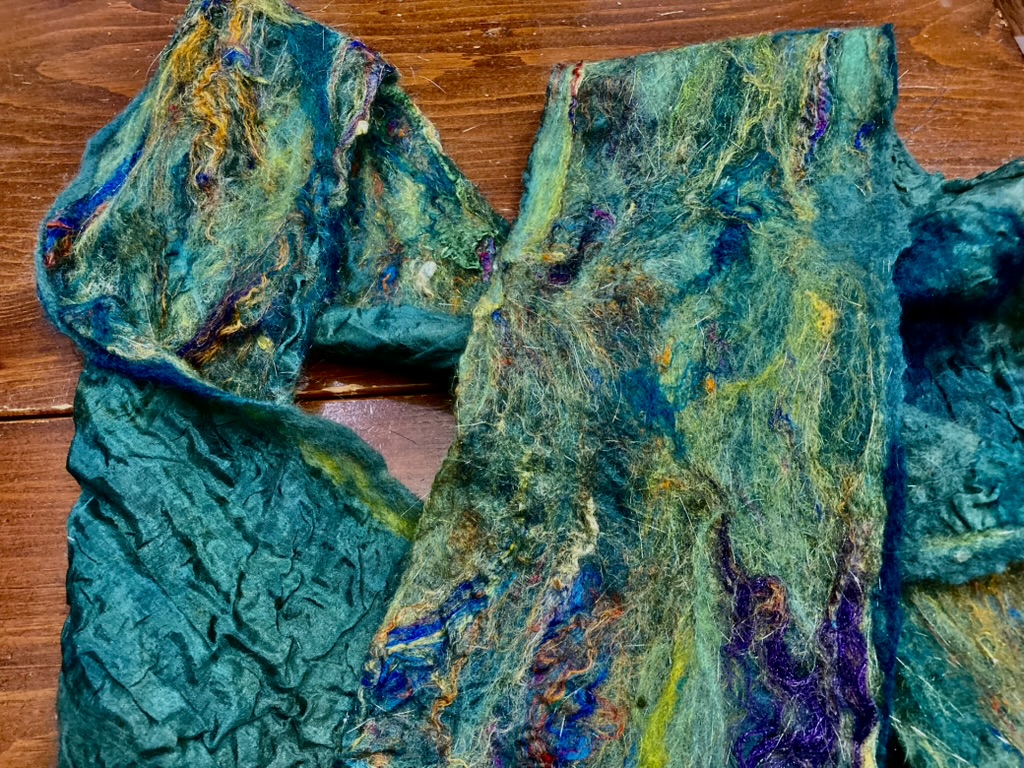
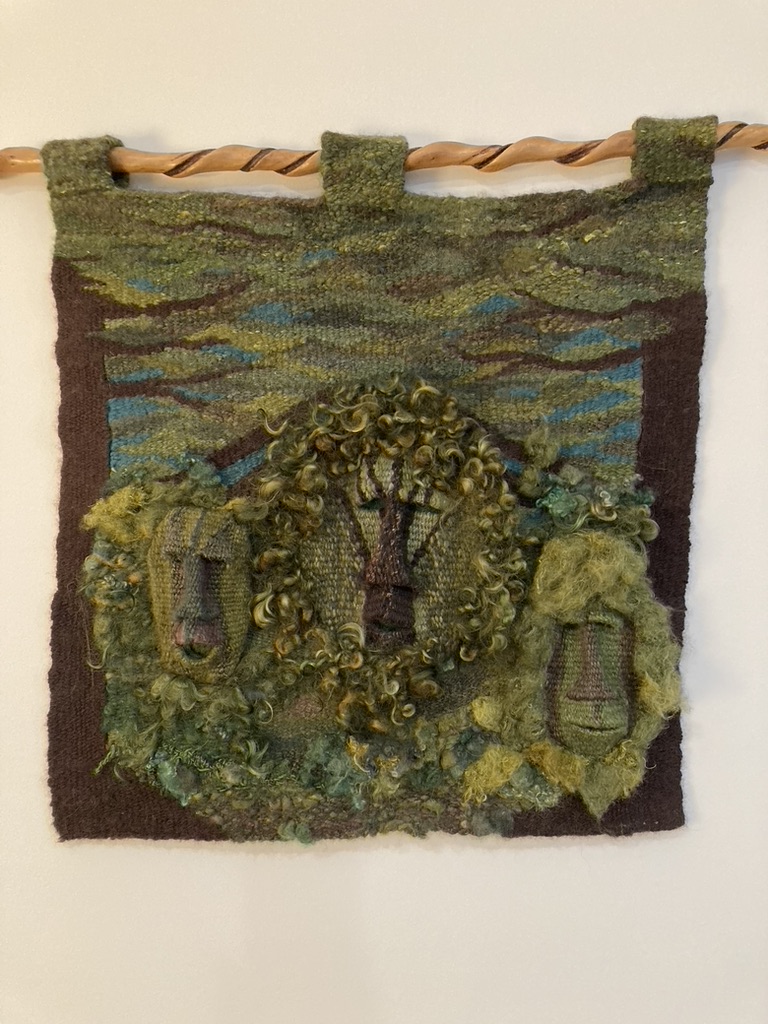
Here is a story that has been very present to me for the last few months. Certainly the actions in the tale spoke to me strongly as, for week upon week, I wove and un-wove and re-wove and un-wove the tapestry for Faces of the Forest . But, deeper than that, the story is telling me something I need to know about the dark times we are in. Whatever the reason, the story holds me in its fierce embrace & asks that I share it with you.

I first encountered it as told, with a Celtic flavor, by Sharon Blackie . I met it again in November, in Michael Meade’s book Why the World Doesn’t End, and then, if I remember right, most recently in a posting by Sharon Blackie, who mentioned that the story originated with the Lakota people.

I give my deepest gratitude to the Lakota tellers who first opened themselves to the story and whose breath and spirit called it into being. And I give thanks to all the storytellers who have, in their own ways, generously lent their breath and spirits to keep the story alive through the years

*******

Somewhere, just at the edge of the place where you dwell — whether prairie or forest, farm or city, mountain or coast — there is a cave, a cave so well hidden that those who have searched have never found it. And in the cave, two beings dwell in harmony. One is a very old woman, so old that even she doesn’t know how or where she came into being. Her face is beautiful, carved and darkened by the flow of time. And with her there lives a large black dog. He, too, is old beyond knowing. He has always been with her, and she with him

The cave is sparsely furnished. There is only room for a large loom and a fire pit encircled with stones. In the pit, a fire burns, and the fire too is so old that even the old woman doesn’t know who first kindled its flames. Over the pit hangs a large clay pot filled with a stew of berries and herbs and seeds and roots and water from an ancient spring — a delicious soup that simmers and bubbles gently, its sweet aroma drifting now and then out of the cave to touch the lands and waters beyond.

All day and all night the old woman stands at her loom weaving and weaving, making the most beautiful garment of yarns thick and thin, a tapestry of such colors and skill as have never before been seen. As she weaves, the old dog dozes and the soup simmers and the garment grows.

Every now and then, the soup begins to burble and gurgle with such loud energy that it catches the ear of the old woman and wakes the dog. Slowly the old woman turns from her loom and hobbles towards the fire. With a long-handled spoon of horn, she stirs and stirs the soup, making sure it doesn’t burn.

The old black dog watches the old woman as she moves across the cave, and that old dog stands up and walks over to the loom. Quickly he bites and pulls and rips and tears the garment from its loom, then returns quietly to his place.

When the old woman finishes her stirring, she returns to find the loom empty and a heap of shredded and raveled yarns tossed upon the floor of the cave. I don’t know if she sighs but I know she is curious, for she bends down and looks and looks at the chaos of tangled textures and hues. Finally one thread catches her attention, calls to her hands. Smiling, she picks it up and begins to weave a new garment. It is a tapestry shimmering with skill and magic, perhaps even more beautiful than the last. And so she weaves and weaves, always listening to the song of the soup; and when it is time, she turns to stir.

I don’t know if this is exactly how it happens, but I know that it is true.

*******

Ben Okri says, “In bad stories words cancel themselves out, and nothing is left. The words return to the source; they desert the page; only meaningless marks are left behind. …. Stories are always a form of resistance. …. The true story-teller suffers the chaos and the madness, the nightmare — resolves it all, sees it clearly, and guides you surely through the fragmentation and the shifting world.”

Let us resolve to tell only good stories, stories that, like the returning sun, illuminate and enliven.

*******

And please forgive me for posting yet again, my old, old poem. It is, as always, my prayer for the Winter Solstice — perhaps now more than ever.

             Turning

Now the earth slides faster down
the long dark days towards Solstice.
We’ve been flung
almost too far from the center,
skidding violently along
the curve of space.

The pace
presses me flat against the rocks,
among the dried debris of summer.
Blackberry canes snarl my hair;
faded petals or leaves,
compressed beyond recognition,
cling to my lips and eyes.

Oh, it’s a long slide
down to the Solstice.

But we
shall be
tugged sunward at last on gravity’s leash:
a cosmic
crack-the-whip.

We’ll hit the corner flying
and careen round into who knows
what great wind of passage.

Even I
may be blown clear out of this cave, clean
onto my feet.

Lifting my arms to
layer upon layer of translucent
color cupped to Earth’s curve,
I’ll feel the thrust of the planet
beneath my feet.
Gulping air straight
from Arctic floes,
I’ll raise my face to
the icy stab of Orion’s sword and
roar
for joy.

— MCK

Life Force, Escaping the Box

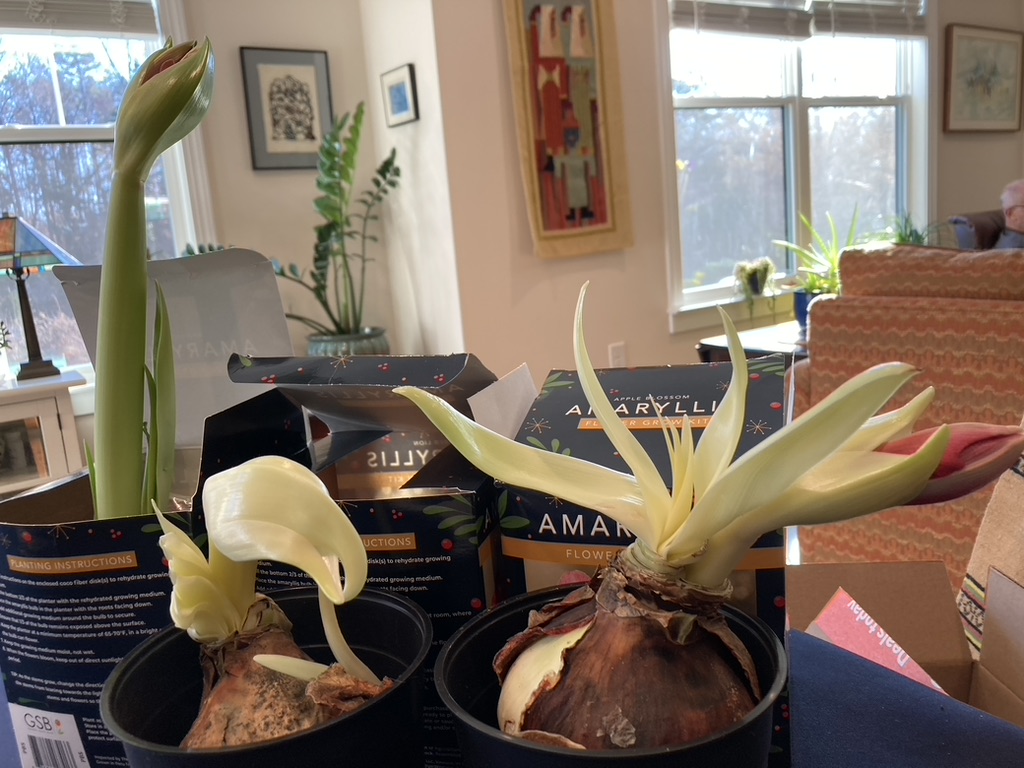
A couple weeks ago, I bought some amaryllis planting kits to give away as part of the winter festivities. I set them on a shelf to wait in the cool of the garage. Four days ago I went to fetch them in for wrapping.

I saw a strong green shoot and bud bursting up out of one box! I noticed that 2 other boxes were bulging strangely.

I opened them to check:

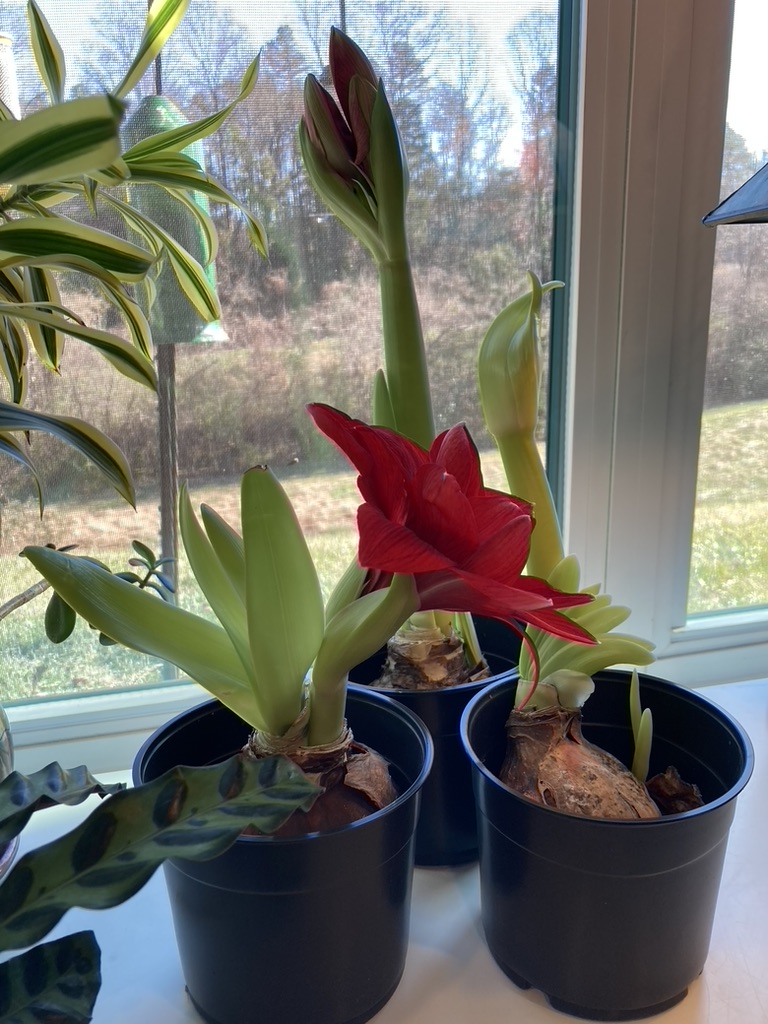
And now, after 3 days of sunlight:

The press of creativity, generativity, coming from the inside, wanting to expand.

How much Life wants to live!

How much I need to learn from these 3 plant beings!


“If you bring forth what is within you,
what you bring forth will save you.
If you do not bring forth what is within you,
what you do not bring forth will destroy you.”

― Gospel of Thomas

Remembering Who I Am

Reading the newspaper and Heather Cox Richardson’s newsletter the other morning, a memory from 1988 surfaced suddenly. My 11-year old son and I had gone to spend part of the summer in Flagstaff, Arizona, while I attended an institute on teaching English as a 2nd language. When the institute’s organized overnight rafting trip on the San Juan River in southern Utah was cancelled, we decided to go anyway. It was a magical trip with many beautiful moments. On the second day, the guide brought us to a deep swimming hole on the river, one that had a natural whirlpool in which we could float round and round. He showed us the one specific spot where we had to kick out in order to escape its pull. Elsewhere, the circular current was too strong.

I watched for awhile. Everyone seemed to escape easily. Finally I swam out to the whirlpool, slipping into its irresistible pull. I enjoyed the experience. As a sort of go-with-the-flow kind of person, it was easy to let the current take control of my body. But, when I’d had enough, I remember an increasing sense of being “trapped.” Did I postpone trying to escape for fear of failure? Did I try several times but miss the exact spot? All I can remember is the anxiety I felt. Eventually, of course, I did kick out at the right point, safe and sound. There was never any real danger. Why had I felt so anxious?

I guess that memory surfaced this morning because it is so easy for me to get caught up in the maelstrom of current crises. How do I kick out of the current so that I am free to swim for shore?

On so many occasions, it is the more than human world that reaches out to save me.

I had long been in love with the kingfishers I’ve encountered in story, poem & picture, but I had never seen one. Then, several weeks ago, something happened. The first time, I caught just a quick glimpse of a white-throated (and perhaps crested?) blue bird out of the corner of my eye, just as he took to the air. I was pretty sure it wasn’t a blue jay. Then could it be…? As if to answer my question, the bird circled & circled overhead, displaying his long beak and calling out a great rattling cry. A quick check of the song on google confirmed my hope. https://www.youtube.com/watch?v=sboXiZ4CIIc

A few days later I got a better look at the kingfisher before he departed. Once more the distinctive rattle again & again, an ancient music that seemed to lift me up as if I, too, had wings — no longer trapped in the human maelstrom but free to dance to his ancient song.

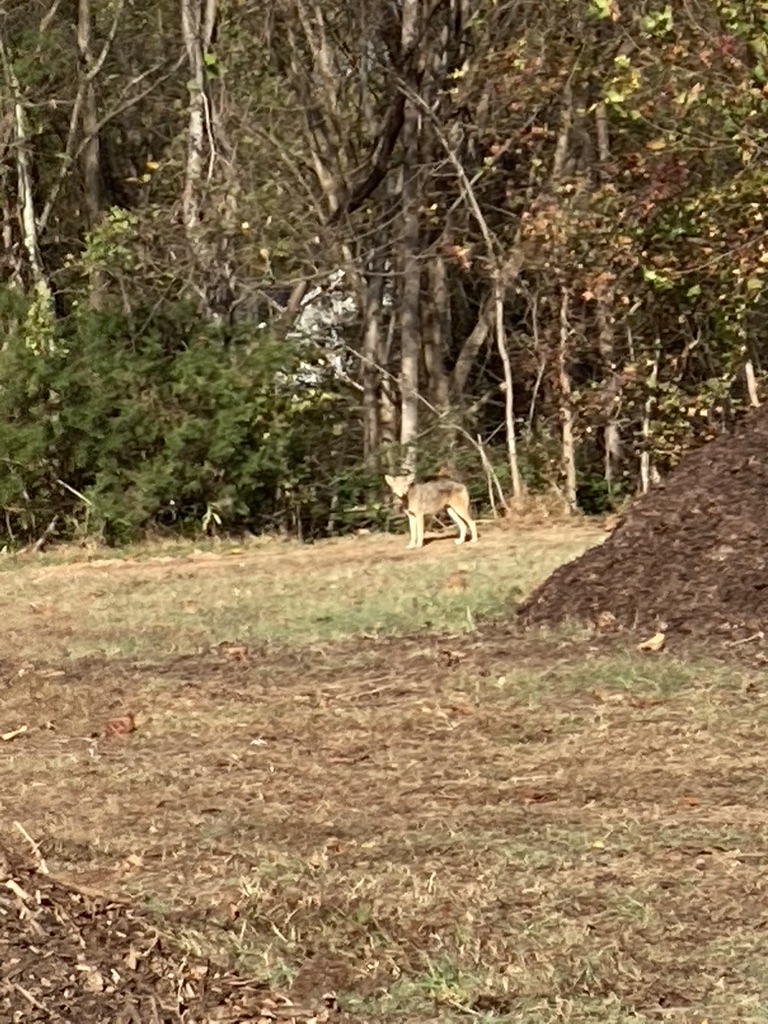
Then two weeks ago I was walking my little dog down past the maintenance workshop, heading for a trail that my husband & a friend had made through the patch of woods here. I felt, more than saw, a movement ahead of us, just at the edge of the woods.

Coyote. He stopped and turned to look at us. My dog stayed quiet. (Did he recognize a potential predator? or was he reacting to the deep stillness within which I was suddenly enfolded?)

Coyote and I studied at each other. After a time, he sat down. ….A bit longer and he seemed to have relaxed even more, enough to lick his nether regions. A loud disturbance behind us caused him to stand and take one step towards the trees, but he soon realized it was just a small ATV hauling mulch. No threat. Something he’d seen many times. He sat down again. We continued to look at each other. After a time, he lay down and stretched out in the sun. And still we both stayed — relaxed, at home. After a while, my old legs tired. I checked my watch and was surprised to find that well over half an hour had passed. Oh, if I’d had a chair I’d have stayed until he was through with his sunbath! What a magical encounter! I was, quite literally, enchanted by his presence, by his gaze. Just when I needed him….. A gift….

It was very different from the encounter I’d had with a coyote on our llama farm in Virginia a number of years ago (one I’ve probably already written about on this blog). There, coyotes denned on the ridge behind our house and often filled the night with the wild flames of their songs. I never saw them but often saw their scat down in the lower woods and in the tree farm across the road.

Then one evening, as I was heading up our path through the woods to the compost heap, I heard a subdued rustling in the bushes and turned, expecting the usual deer. Slowly, deliberately, a coyote stepped out of the woods next to me and stopped. We looked long & long into each other’s eyes from just a few feet away. Then, apparently satisfied, he turned and slid once more into invisibility amongst the trees knowing perhaps that he with his wildness had somehow dominated our brief silent conversation.

This meeting with a rural coyote was so unlike the recent one with the more relaxed urban coyote who was used to humans and no doubt well aware of his protected status within the city. The coyote I saw here in Greensboro was certainly not domesticated but he seemed to lack the sharper wild edge of the other. Still, I cannot help but admire the urban coyotes, wily tricksters that they are. I think it was Gavin Van Horn who wrote that in Chicago, coyotes have learned how to read the traffic lights to avoid being hit by a car. Whether in the city or in the forest, it is an honor to live among such beings.

And, whether with kingfisher or coyote, each of these encounters kicked me out of the human maelstrom of despair and reminded me of who I am: one being inextricably interwoven with all other beings — those we call animate and those beings (like rocks, air, water, fire) whose lives seem more hidden from us; an active participant of the exquisite & ever-changing fabric of the Earth community, indeed of the Cosmos.

In the Nov. 23 post on his excellent “Into the Deep Woods” blog, James Roberts wrote:

“I’ve recently discovered the term Horizon Goal, which I’m finding helpful. Horizons, of course, are unreachable, so the term is koan-like. Horizons make for unachievable goals, but the journey towards them is where the work (and adventure) is. My own horizon goal is this: to create art and books which celebrate and defend the wild. I hope to do this for the rest of my life. There is a Masai proverb I remind myself of constantly: If the lion has no praise singer, the tale of the hunt will always be told by the hunter. I’ve printed it in several of my publications. These past few weeks have been a time of dread for those of us who orientate ourselves to wild places. The governments of the world seem to be slipping into the hands of borderline lunatics with no interest whatsoever in correcting the imbalances we’ve imposed on earth. The conferences dedicated to climate change and protecting nature seem to be run by those who seek to do the opposite. So it feels important that even quiet people like myself praise lions, snow leopards, spirit bears, river otters, blue herons, red-tailed bumblebees, luna moths – all the myriad of species and the wild places they occupy – as loudly as we can, while we can. It’s a way to share the wonder and mystery that surrounds us always. And it’s a way out of despair.”

I finally “finished” Faces of the Forest: Community just before Thanksgiving. I don’t know whether it communicates what I’d hoped, but it is time to let make its own way into the world. May my goal be not a “finished piece” but a walk ever toward some unattainable horizon.

As Jame Roberts said, simply an attempt of share the wonders we experience in the world is another way out of despair.

How do you find your way out of despair? How do you remember who you are?

Poems for this time

Sometime in the last several days, I decided (realized?) that — whatever the future might hold — the important thing was to not be afraid, for it is fear that has brought us to the place where we are in the U.S.

And just now, as I was typing, I remembered a prayer/blessing/reminder that says exactly that:

"The world is a narrow bridge,
and the most important thing is
not to be afraid."


--Rabbi Nachman of Breslov, early 1800s --

Yesterday, instead of letting anxiety overwhelm me (as it has so often these last months), I found — or was given — a place of peace, a firm footing, the sense of rootedness and holding that Old Oak, growing on the side of very steep slope, has been trying to teach me.

I didn’t stay up late last night waiting for the election results. This morning I began the day (as I have been doing most days lately) by choosing a song [today, The Grateful Dead’s “Ripple”] and dancing — dancing back into my body, into the present moment. Then I was ready find out what had happened, to read the news.

I am deeply, deeply saddened that more than half the voters in my country have chosen to move forward on paths that seem to be paved with anger and fears — both their own (which are real) & those they were taught through the telling and re-telling of false stories.

As so often, I turned to poetry for help.

William Carlos Williams wrote :

“It is difficult
to get the news from poems
yet men die miserably every day
for lack
of what is found there.”

These 2 poems gave me some news of the world as it is — and hints about what I am/we are called to do in response.

                A Ritual to Read to Each Other
by William E. Stafford

"If you don't know the kind of person I am
and I don't know the kind of person you are
a pattern that others made may prevail in the world
and following the wrong god home we may miss our star.

For there is many a small betrayal in the mind,
a shrug that lets the fragile sequence break
sending with shouts the horrible errors of childhood
storming out to play through the broken dike.

And as elephants parade holding each elephant's tail,
but if one wanders the circus won't find the park,
I call it cruel and maybe the root of all cruelty
to know what occurs but not recognize the fact.

And so I appeal to a voice, to something shadowy,
a remote important region in all who talk:
though we could fool each other, we should consider—
lest the parade of our mutual life get lost in the dark.

For it is important that awake people be awake,
or a breaking line may discourage them back to sleep;
the signals we give — yes or no, or maybe —
should be clear: the darkness around us is deep."


                       Narrative Theology #1   
by Padraig O Tuama

"And I said to him:
Are there answers to all of this?
And he said:
The answer is in a story
and the story is being told.
And I said:
But there is so much pain.
And she answered, plainly:
Pain will happen.
Then I said:
Will I ever find meaning?
And they said:
You will find meaning
where you give meaning.
The answer is in a story
and the story isn’t finished."

*******

On a lighter note, last night my husband got up and went into the dark kitchen to get a drink of water. He picked up yesterday’s water mug but, rather than drinking from it as usual, he first emptied it into the sink. He felt something crawling onto his hand and flung the thing off. Then he turned on a light. It was a tree frog! How did it get into the house, let alone into a mug on the kitchen counter? He carefully carried it out into its usual world. (Unfortunately, he didn’t take a picture.) I take the frog’s presence as a good omen. In many cultures, a frog is a sign of healing. May it be so.

I am sending you all love & blessings & prayers for peace. May we remember and tell the good stories — the ones that bring Light, Life, Compassion, and Kindness into our hearts & into the world.

When the Mask Speaks

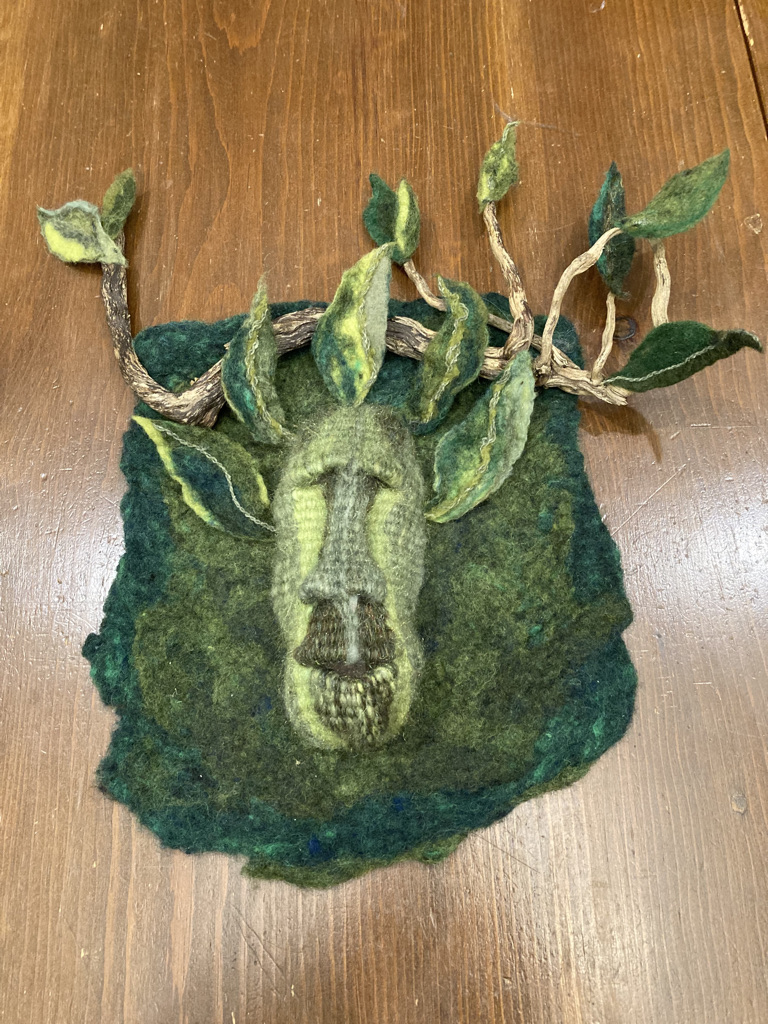
I receive healing from the more-than-human world. During this stressful summer and early autumn especially, I have been enlivened, inspirited by the infinite variety of greens that make up the strip of urban woodland behind our house and adjacent wooded areas — my teacher Old Oak and new saplings and thistles, ferns, mosses & lichens, the many shades & shapes & textures of bark — all the faces of the forest.

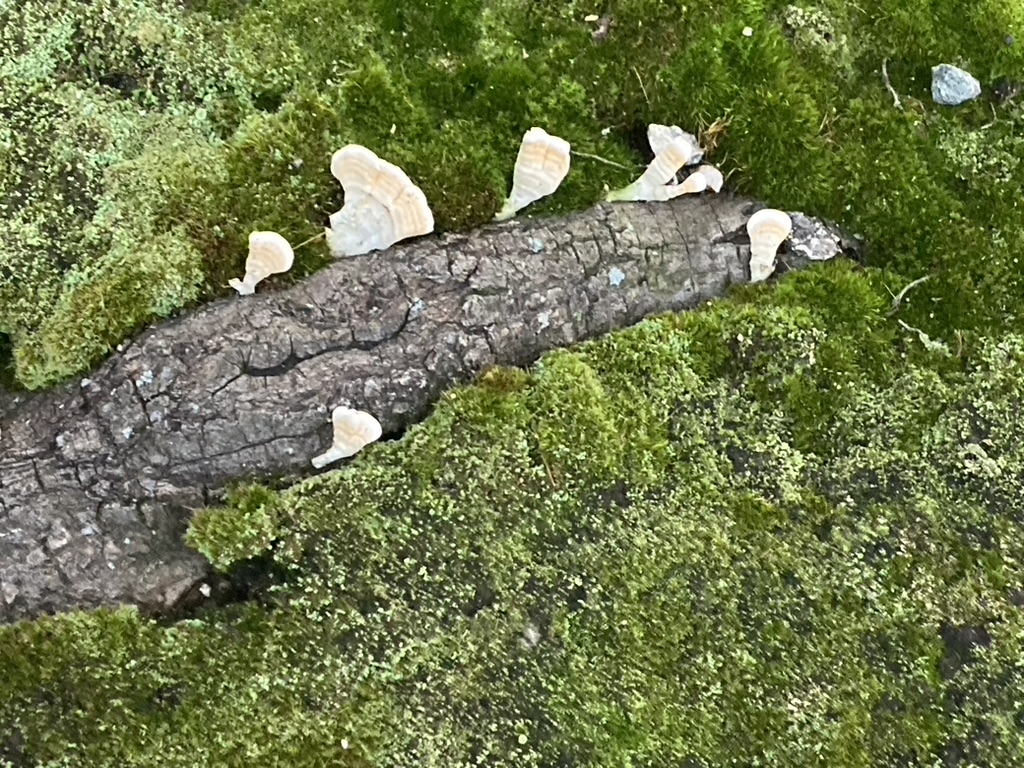
I receive healing from the green world that surrounds me. Especially during the turbulence of this summer and autumn, I have been calmed and inspirited by the myriad colors and textures of the patchy urban woodlands I see every day. Oak, pine, maple (now fiery with the turning season), all the different barks, lichens, and mosses. Some days it is especially the mosses — their tenacity and ability to turn even rock into soil; the seemingly magical fairy forest of their tiny spiraling leaves; the soft comfort they offer when touched gently. Mosses may fade during drought but flare forth in brilliant greens again at the first touch of rain. They help me remember how it can be.

Something about greens….. Late last winter, I often found myself looking often at Mother Moss, Old Oak: Resilience, and Willow: Healing — 3 pieces that farmers and flocks and dyers and I had invited into the world years ago.

Willow-Healing

Soon I noticed that I was suddenly acquiring more green fibers, more textures,
…but nothing emerged until…

In the spring, Judith-Kate Friedman generously offered a free afternoon of creative play on Zoom. We were invited to bring to it our own “toys” — any materials with which we wanted to play & explore. I warped a tiny loom and brought green wools and some luscious hand-dyed bronze-green Wensleydale locks.

Permission to play!

I am amazed when I stop to think about it — how rarely I give myself permission to just play with materials or words — and, even when I do, how often what was supposed to be play slides into something else.

With her usual magic, Judith-Kate created a container where deep and joyful play was possible. And so it began. I just let my fingers scribble….

…. and it was fun and I wanted to do it some more …

And so…

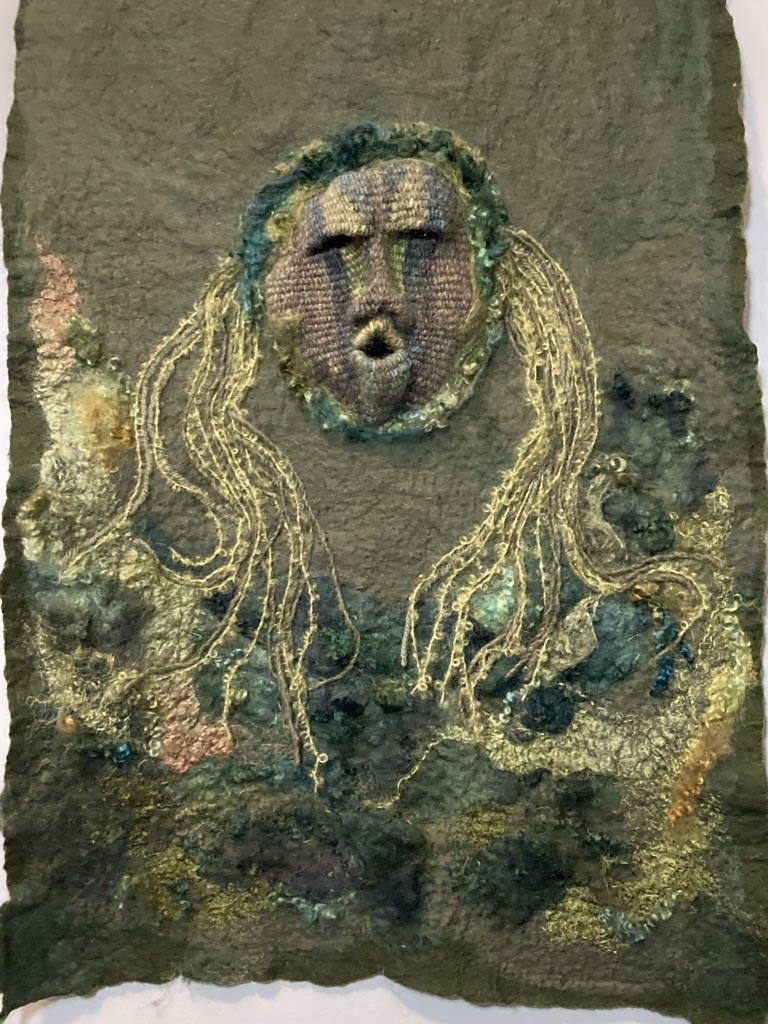
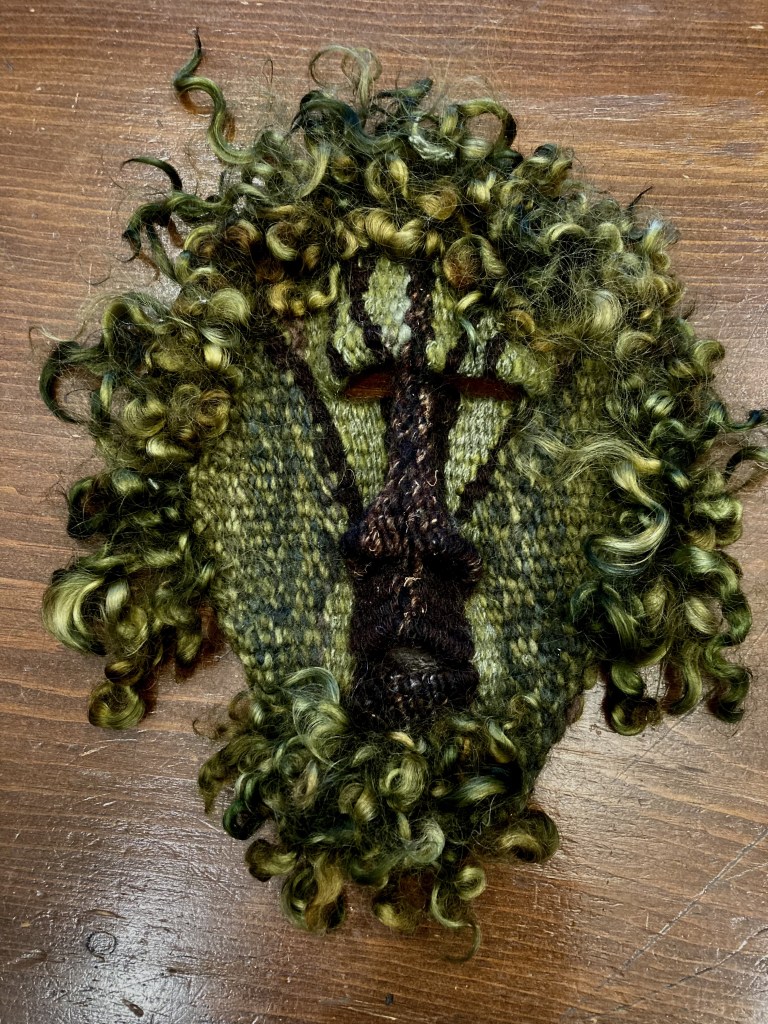
I can’t seem to capture in a photo the colors and the vibrant living presence of this being who emerged on my loom. I have never had such a strong reaction to one of my masks. I always feel a sense of responsibility toward the beings who emerge and for the context in which they will dwell. But my reaction this time was stronger, different. Quite simply, I fell in love. Little did I realize what a demanding creature he would be!

I understand that the making I engage in is not “my” production but an on-going conversation between me and the materials and their origins, and eventually with the masks themselves — a kind of co-creation. Most of my masks find homes in felted contexts but this time, as I began to arrange the fibers to felt, the Green Man spoke loudly and unmistakably: No!

He demanded a woven background — and he decreed that it must be one made with only hand-spun yarns.

I haven’t spun much for years (decades?) and I was never very good at it. Most recently, the little bit of spinning I had done was deliberately uneven and textured yarn. I did make myself spin yarns for the Green Man’s face because the unspun fibers I thought I’d use for the setting had been hand-dyed (not by me) in the same colorway as the gorgeous locks & I wanted the face and its context to blend together. But to spin for a whole tapestry? And doesn’t tapestry demand fine, even, consistent yarn? Little hope for that!

Still, obedient to the Green Man’s request, I began with trepidation. Eventually, as I spun, I relaxed and found pleasure in the smooth repetitive action. After awhile, some of the yarns even became a little more consistent. I spun on.

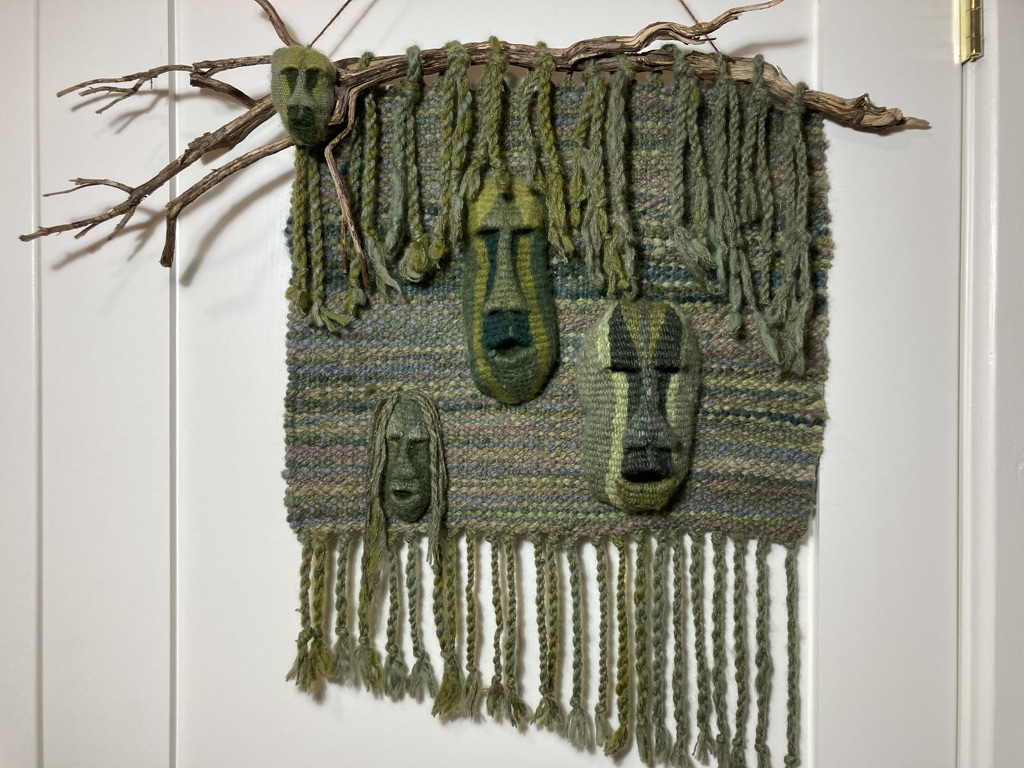
Weaving a tapestry out of a mix of thick and thin and some lumpy bumpy yarns was challenging, and I was making up the pattern as I went along. There were many days when I looked at what I’d done, shook my head, and un-wove even more than I’d woven that day. Sometimes I felt frustrated by the un-weaving, by the lack of “progress”. I tried to remember how slowly a forest grows, how parts of it must fall away to make room for something new. Not a rigid plan, but an emerging ecosystem.

Then, as I progressed, I discovered the Green Man wanted company. I shouldn’t have been surprised. This is what had happened as I tried to create Willow: Healing. After all, a forest is a community. So — spinning more and finer yarns for smaller masks…. Slowly, slowly, slowly….

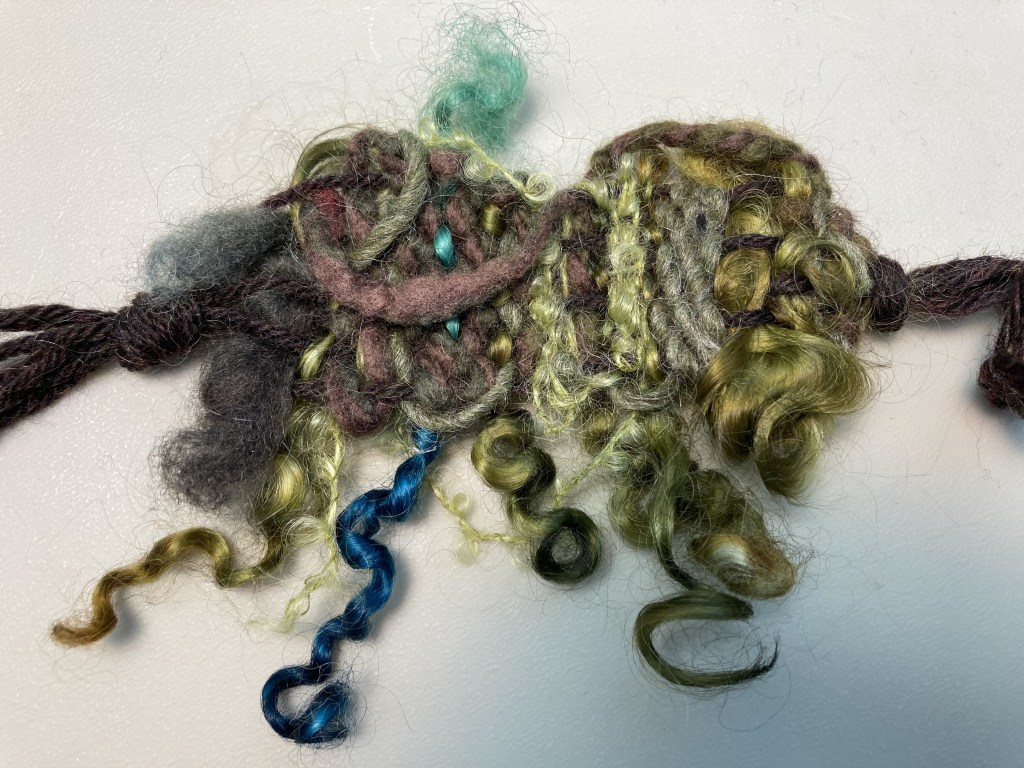
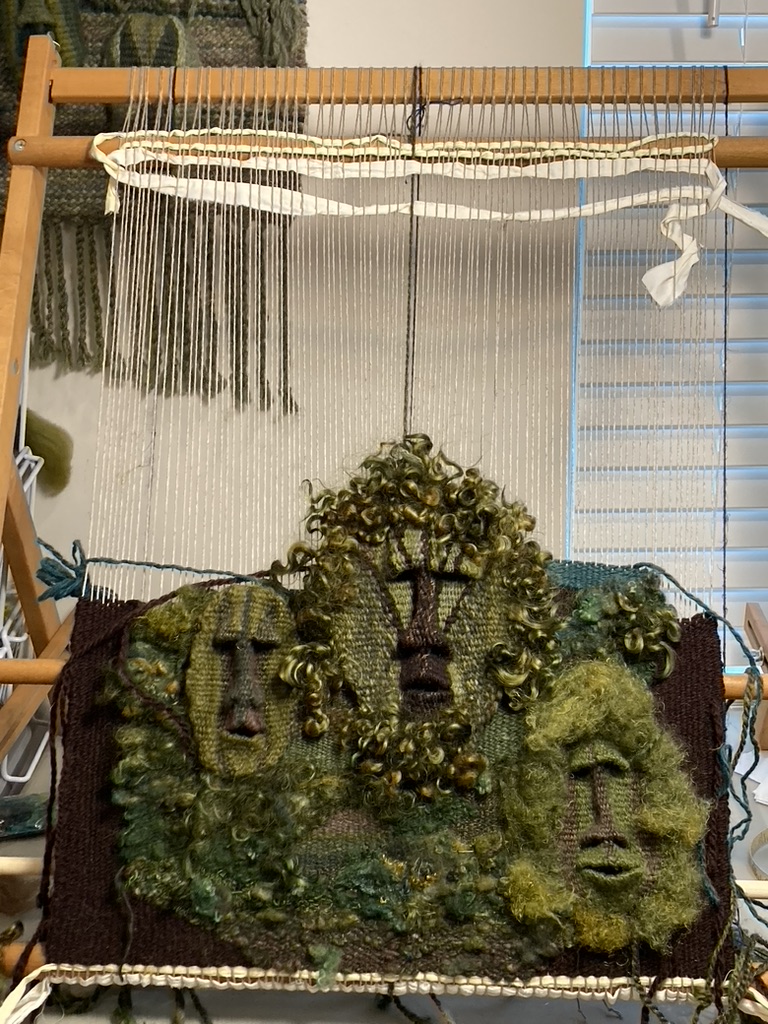
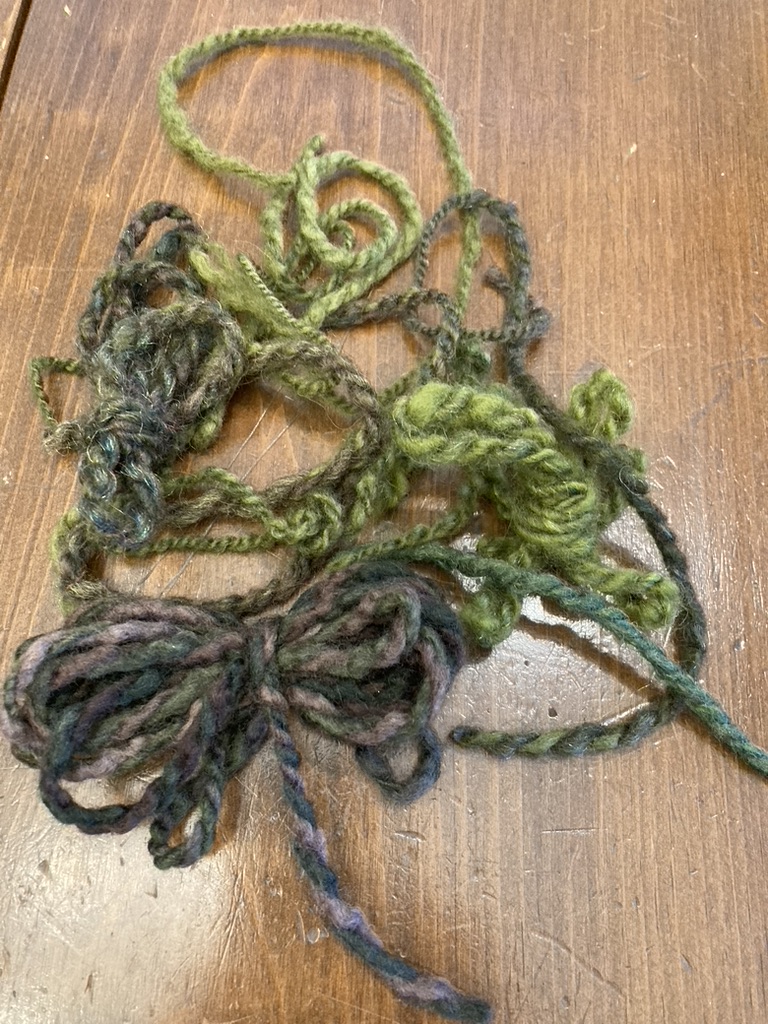
As I approached the end of the weaving — the upper limit of the loom — I found I was running out of my green yarns & began to worry about how I’d finish. But by luck, not planning, things came out just right. When, several days ago, I finally finished the weaving, only this handful of yarn remained.

I meant to take a photo while the weaving was still on the loom, but I found myself fearing that if I looked too long, I’d start un-weaving again. I quickly cut the warp threads before I could change my mind.

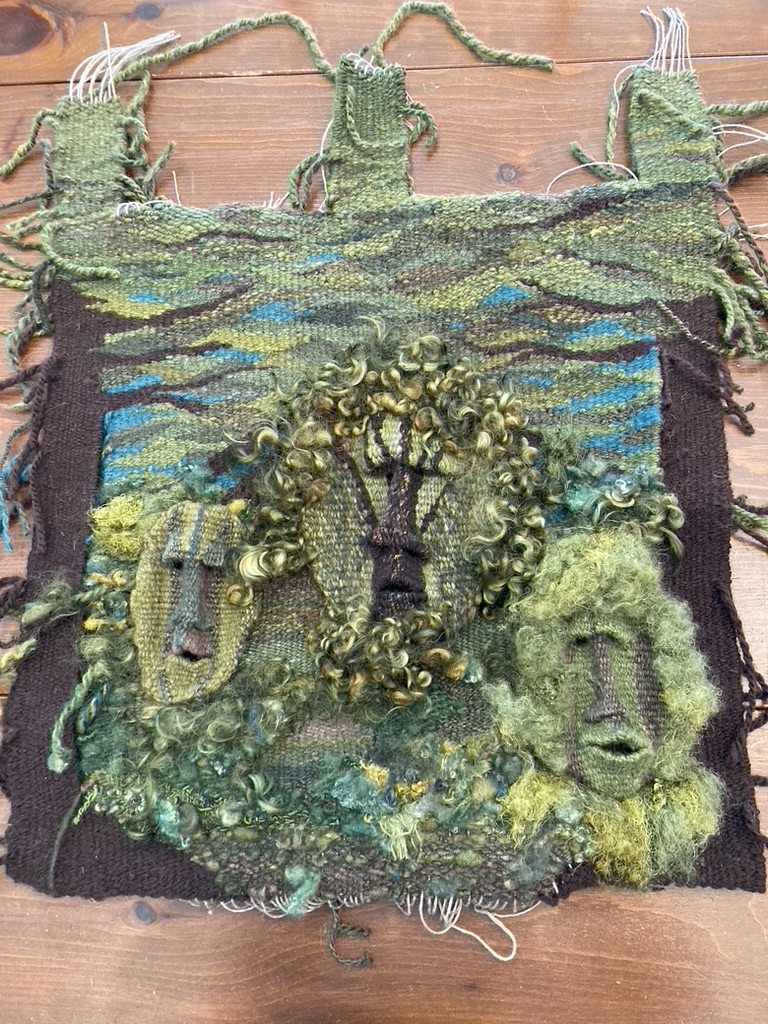
Faces of the Forest: Resilience

Of course, there’s still work to do: sewing in warp threads, needle-felting the yarn ends into the back, sewing on the masks. Still much to discover, to learn.

In general, I don’t enjoy the stabbing motion of needle-felting; I would rather caress the fibers. But this time I am finding the slow pace and quiet rhythm of the action is calming. And there is something satisfying about integrating all the loose ends. I hope this work will help me retain equilibrium as I encounter the turbulent emotions and PTSD [from my 5 years working in a dictatorship — Libya] that are arising as wars, disasters, starvation, & extinctions sweep the globe and as the U.S. faces a future-defining election that pits democracy against authoritarianism.

How I do the work is how I make myself.

I know there is no way that my words or the work of my hands can express the deep joy I feel knowing we are all active participants in the larger-than-human Earth Community. Still, I have to keep trying. And as I engage with this piece, I inhale the green fragrance and something of the spirit of the beings with whom I (and the sheep who grew the wool) have exchanged every breath since the beginning of our lives. I give gratitude to the green beings who feed us and who continue to nourish the human imagination with more gifts than we can ever comprehend. For me the making has been like walking in a forest, remembering how to be here, in this world, in this story. I long to share that feeling.

When I am Among the Trees
~ by Mary Oliver ~

When I am among the trees,
especially the willows and the honey locust,
equally the beech, the oaks and the pines,
they give off such hints of gladness.
I would almost say that they save me, and daily.

I am so distant from the hope of myself,
in which I have goodness, and discernment,
and never hurry through the world
but walk slowly, and bow often.

Around me the trees stir in their leaves
and call out, “Stay awhile.”
The light flows from their branches.

And they call again, “It's simple,” they say,
“and you too have come
into the world to do this, to go easy, to be filled
with light, and to shine.”

“What I Did On My Summer Vacation”

"As you remember and record,
you pass the story, and the memory,
back through the heart once again."

C. Chambers, 2004

Do you remember the stories our teachers asked us to write on our 1st day back in the fall? “What I did on my summer vacation.” Here is a much abbreviated list of some of the things I was doing on mine.

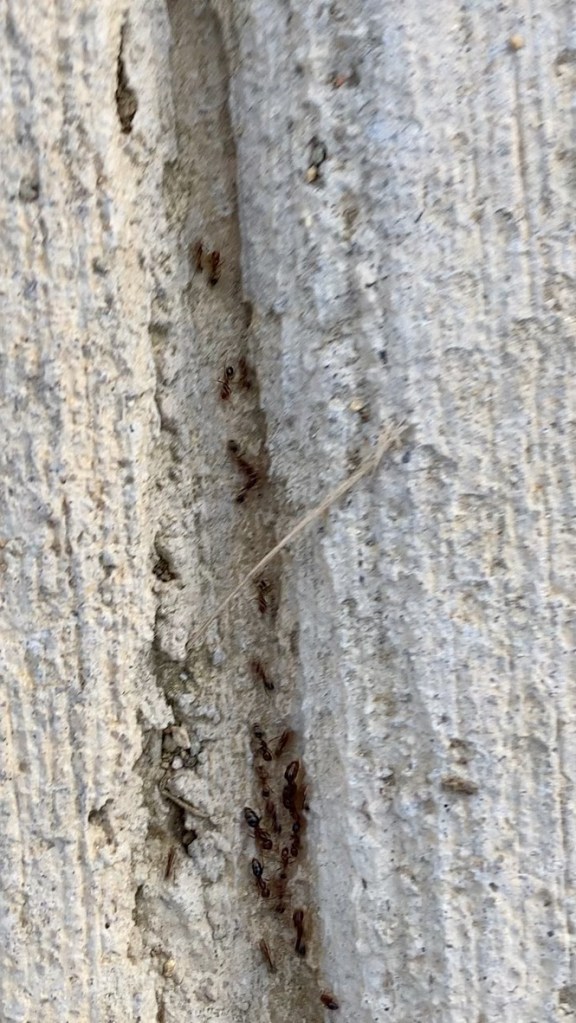
Watching ants use a crack between cement blocks of the sidewalk as a safe super-highway.

Seeing a sprouting potato turn into a strange barren desert landscape with the most amazing exotic plants growing in clusters.

Drawing inspiration from the algae art on an old bench.

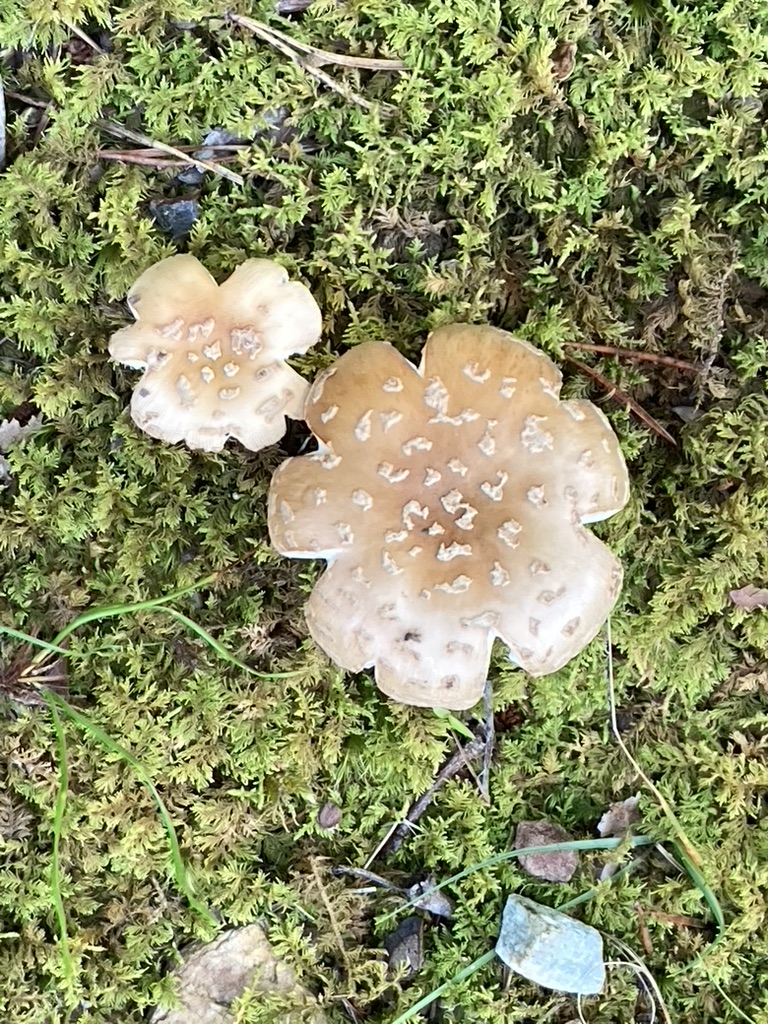
Reveling in the endless variety of shapes and textures created by the Earth.

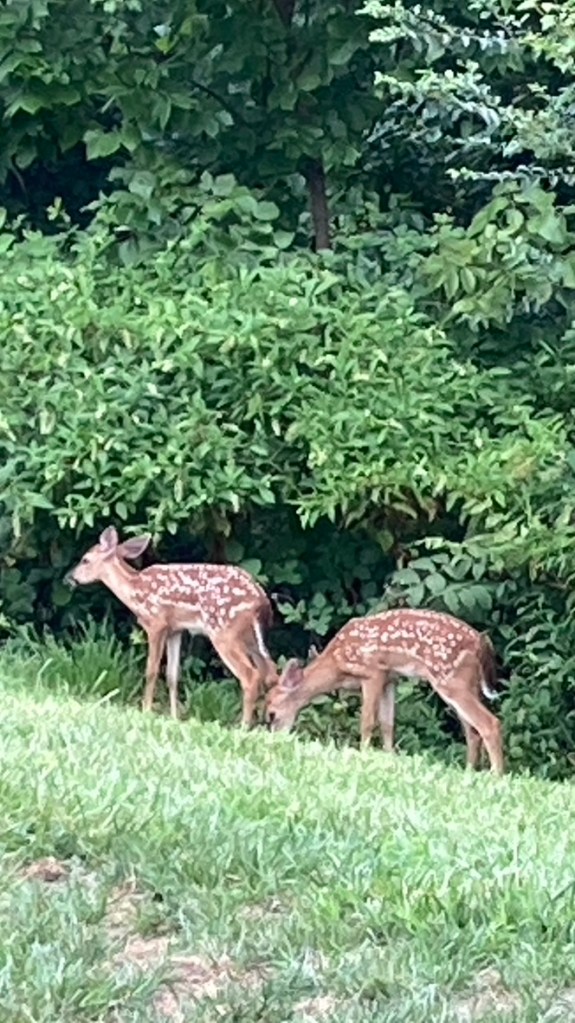
Finding endless delight in the twin fawns who have been growing up in the woods behind our house.

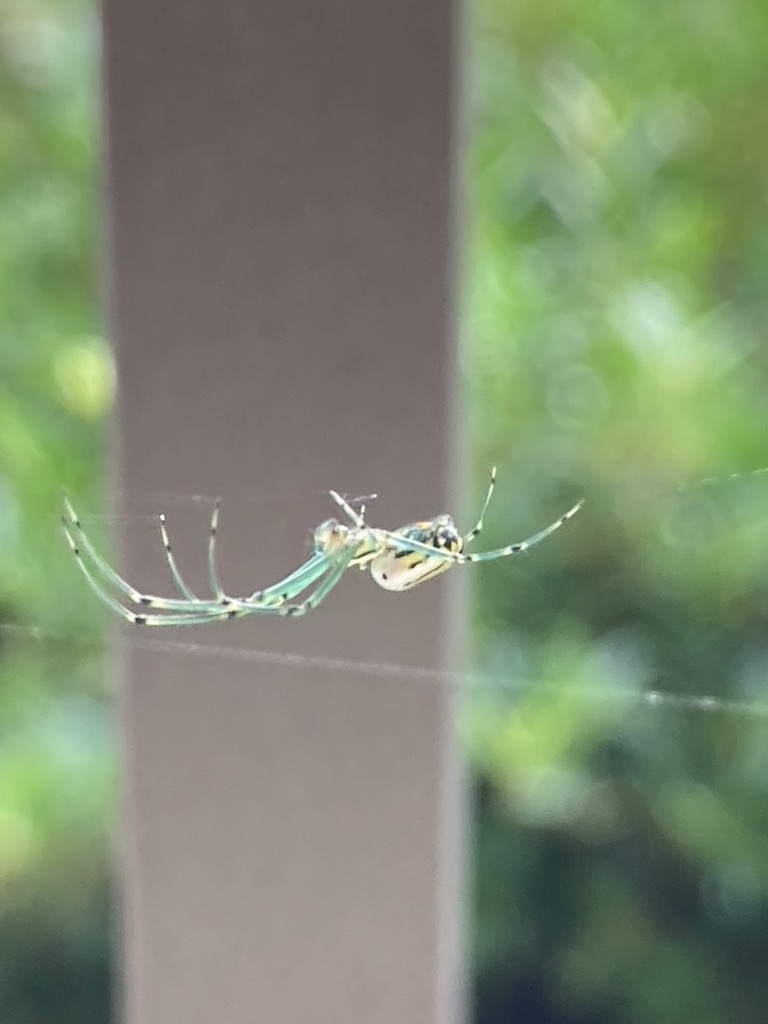
Marveling at the intricate webs of spiders and the glorious flash of dragonfly wings — and then pondering the places where they meet in the endless cycle of life and death.

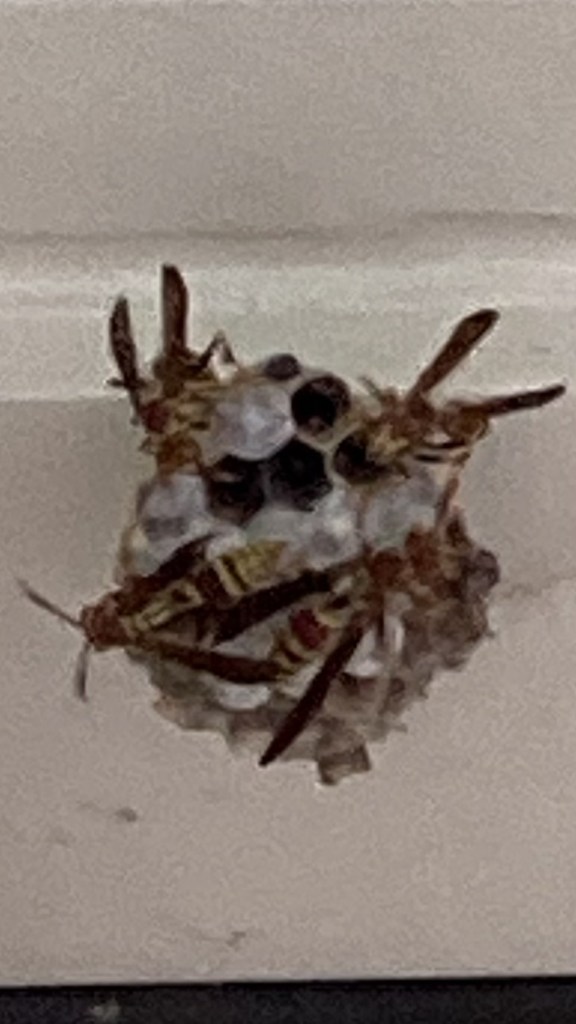
Admiring the makers – the finches building nests on our two porches, the tireless spiders filling space with their complicated structures, and the hornets working together to build their home. Fiber artists all!

(I, too, did some making over the summer. More about that next time.)

I also found myself reading each day, as I’m sure you did too, about wars, storms, droughts, fires, human inequities, species extinction, and the authoritarian drum beat that threatens this and other nations. I heard the lies, deceit, disinformation, conspiracy theories, and just plain disrespect that masquerade as news and wondered at the ease with which so many have been seduced into believing that false painting of “reality.” Sometimes it has been hard not to succumb to a numbing, paralyzing despair.

Theodore Roethke writes so beautifully:

In a Dark Time

In a dark time, the eye begins to see,

I meet my shadow in the deepening shade;   

I hear my echo in the echoing wood—

A lord of nature weeping to a tree.

I live between the heron and the wren,   

Beasts of the hill and serpents of the den.

What’s madness but nobility of soul

At odds with circumstance? The day’s on fire!   

I know the purity of pure despair,

My shadow pinned against a sweating wall.   

That place among the rocks—is it a cave,   

Or winding path? The edge is what I have.

A steady storm of correspondences!

A night flowing with birds, a ragged moon,   

And in broad day the midnight come again!   

A man goes far to find out what he is—

Death of the self in a long, tearless night,   

All natural shapes blazing unnatural light.

Dark, dark my light, and darker my desire.   

My soul, like some heat-maddened summer fly,   

Keeps buzzing at the sill. Which I is I?

A fallen man, I climb out of my fear.   

The mind enters itself, and God the mind,   

And one is One, free in the tearing wind.”

from Collected Poems of Theodore Roethke

What,” Roethke asks, “is madness but nobility of soul at odds with circumstance?”

My mentor Judith-Kate Friedman added, “What is health but facing circumstance with presence?”

Spending time with the beauties and marvels of this creative Earth helps keep me present, grounded, aware of my place and my responsibility as one of the myriad, wonderfully diverse participants in the on-going emergence of the world. It helps me face my/our circumstances with true presence. It helps me, in Roethke’s words “climb out of my fear” and stay open to wonder and possibility.

Finding Balance

“Maybe what we can do when we feel overwhelmed is to start small .”

~~~ Aimee Nezhukumatathil

I am overwhelmed by all the current crises, especially the recent court decision that seems to spell the possible end of democracy in my country by setting one person, the President, above the law. This opens the way for a dictatorship. Have you ever lived in a country run by a dictator? I lived and worked in Libya for five years, arriving just weeks before the 1969 coup that put Gaddafi in power. At first the Libyans were hopeful about a “new beginning.” They soon learned that there is nothing positive about authoritarian rule. It is no exaggeration to say that I tremble at the mere possibility of such a thing happening here.

I am taking time to find my balance by loving the world at my doorstep. 
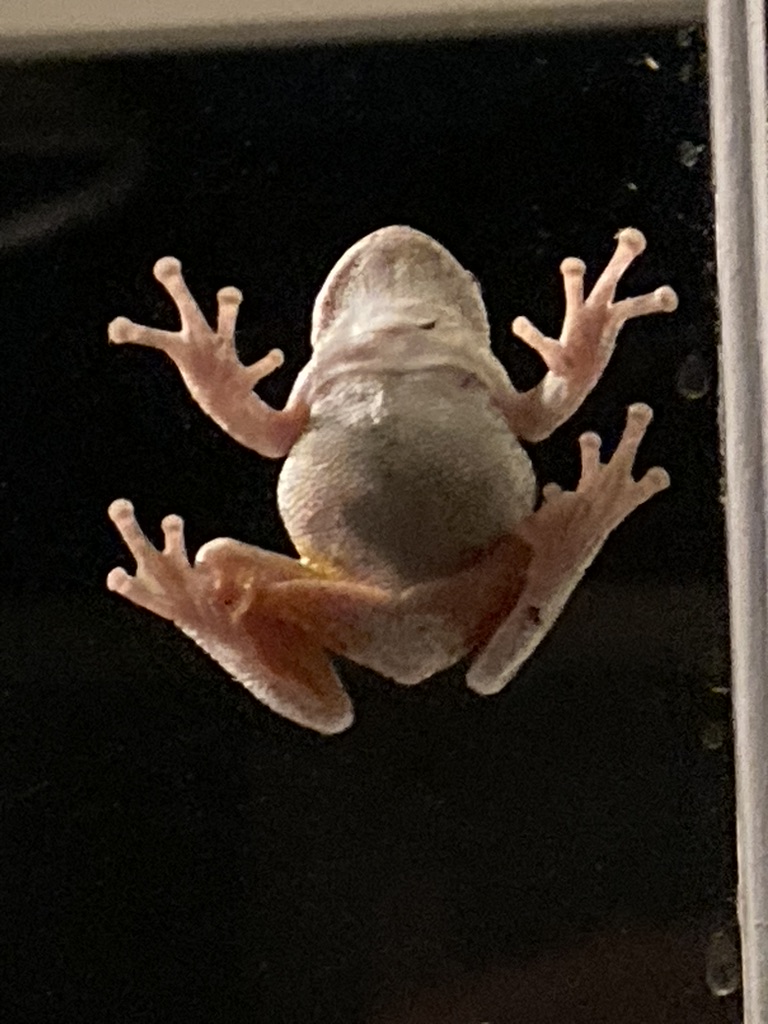
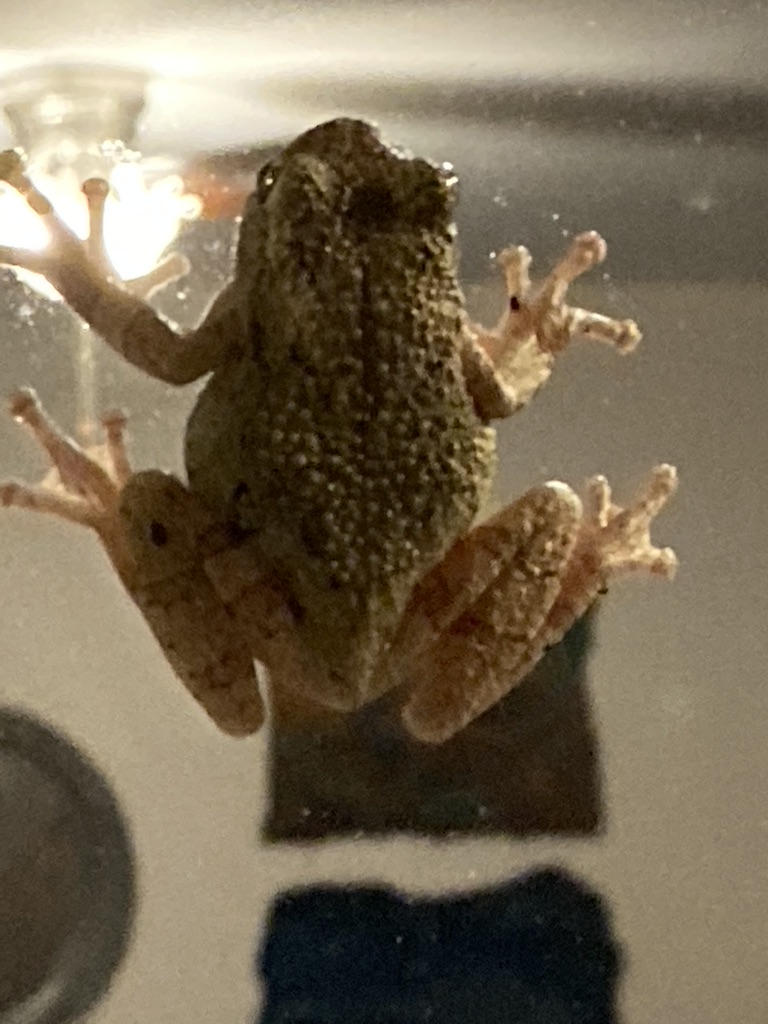
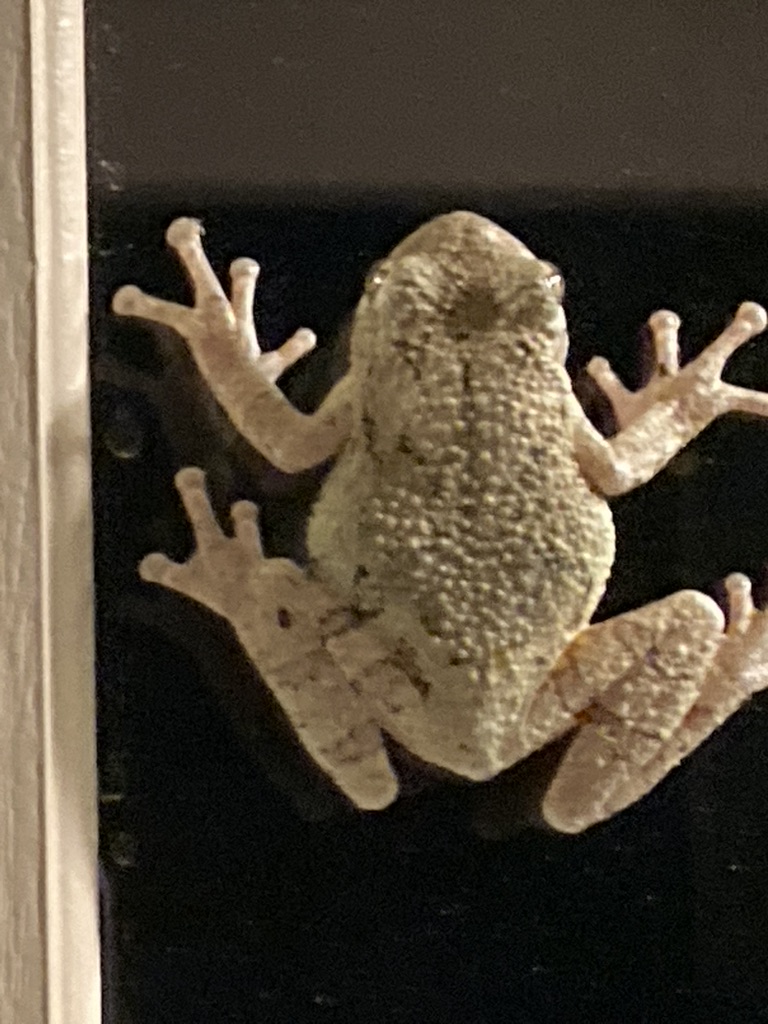
Loving what's near wasn't difficult when an unexpected visitor showed up on my back door one night.

So unexpected and so beautiful!

The magical fingers and toes, the fat tummy, the vulnerability.

Tree frog!

And then, there is the endless flow of life on our front porch:
And the pond with all its beautiful creatures:
The evening chorus of frogs,
swallows dipping and gliding in pursuit of insects,
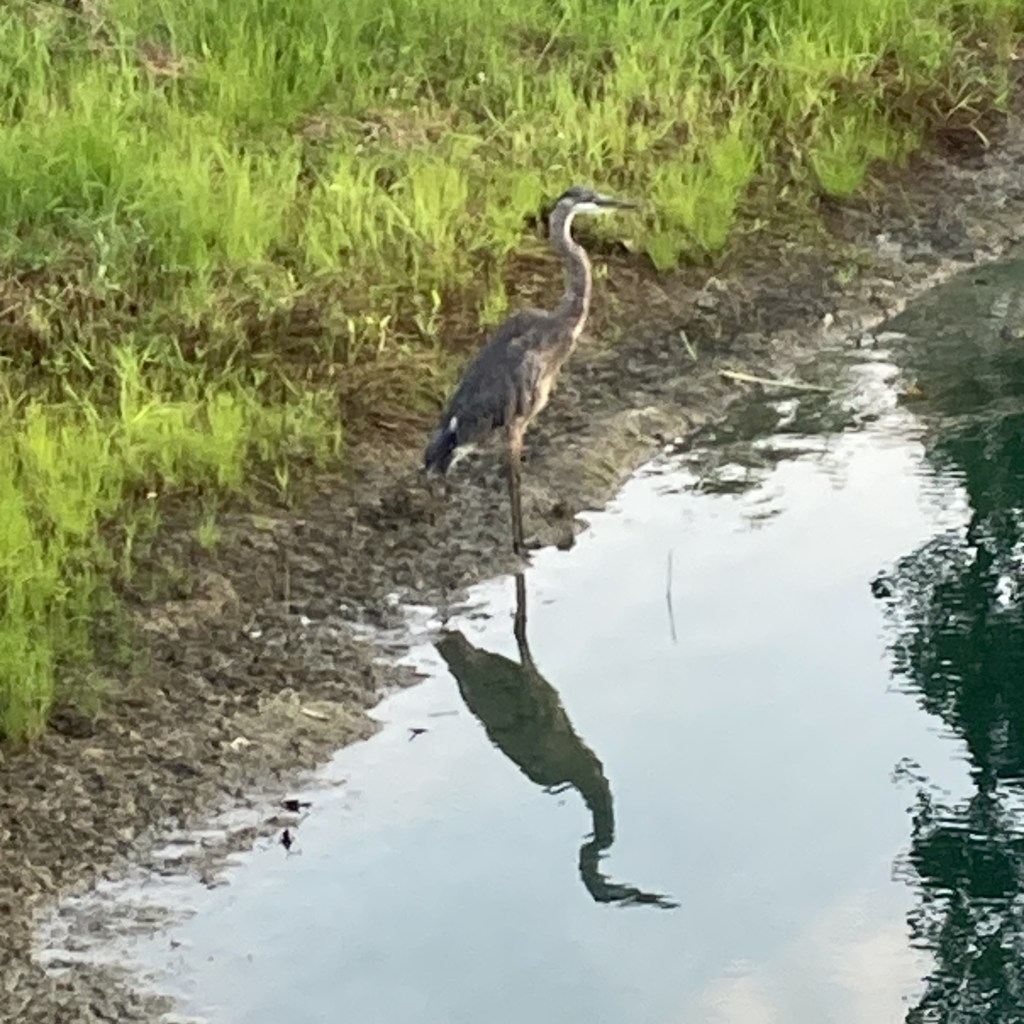
sometimes ducks or geese or a Great Blue Heron
arriving majestically on his wide wings and then standing
absolutely
still.

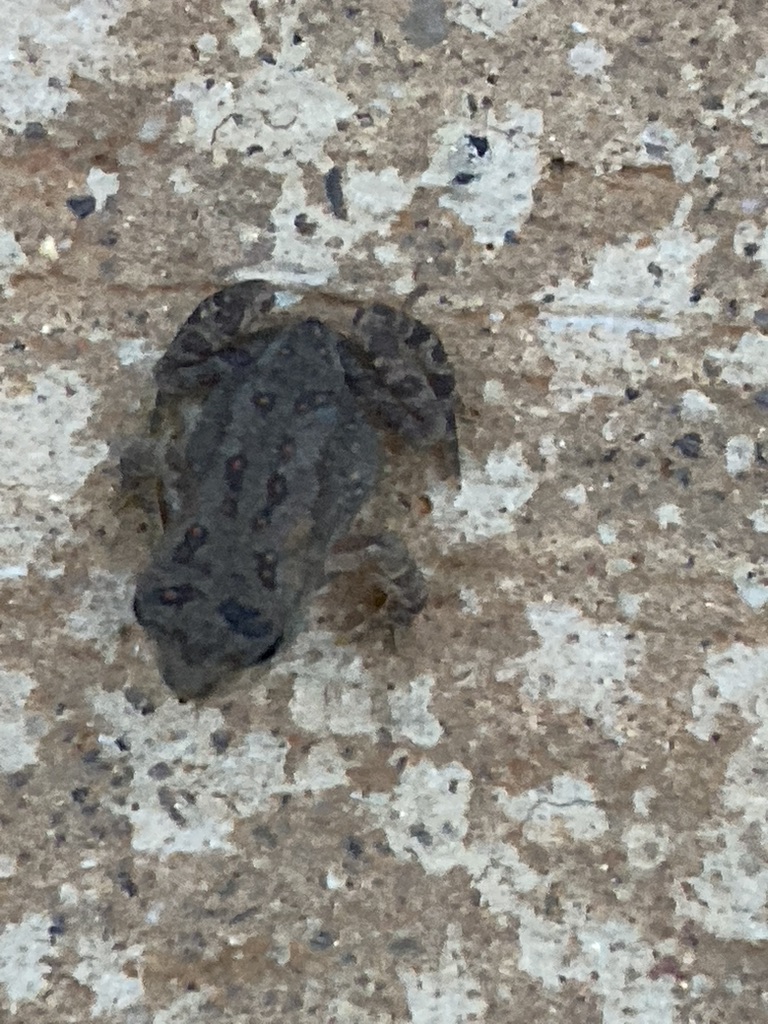
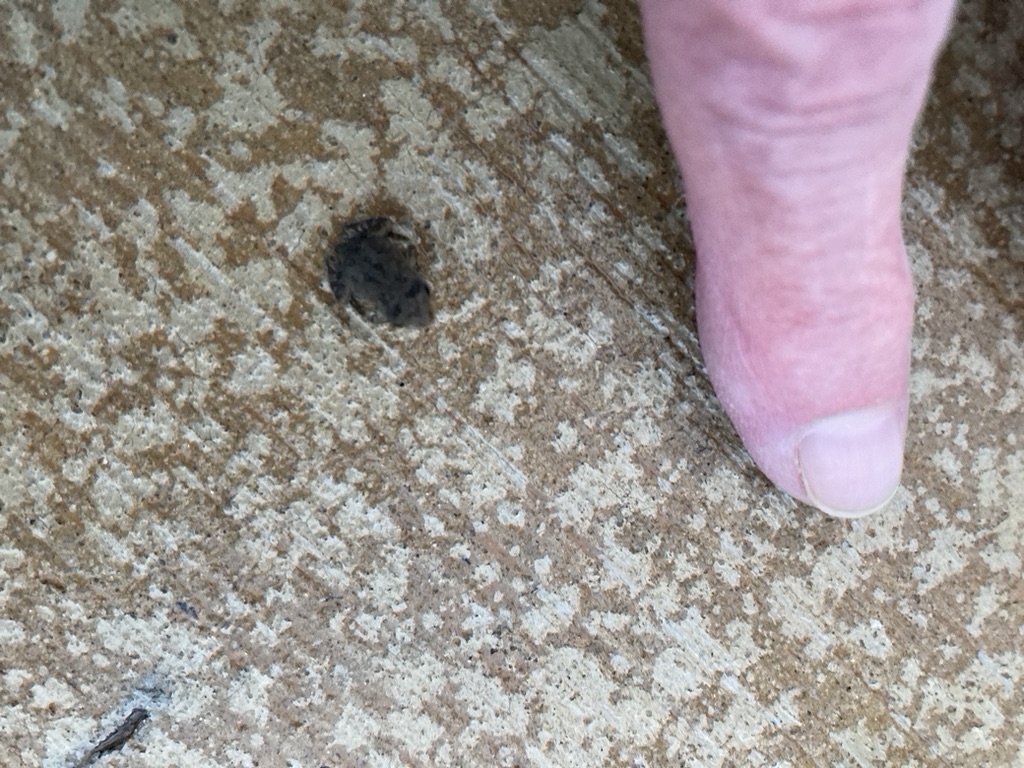
Or perhaps, at dusk, some Little Grass Frogs on the sidewalk around the pond --

— the smallest of North American frogs, no bigger than my fingernail.

* * * * * * *

“Be, Behold, Become”

https://www.beholdnature.org/

* * * * * * *

And always Kabir reminds me:

"Wherever you 
are
is the entry point."

Joy

It doesn’t take something huge and flashy to ignite sheer joy.

What could be more beautiful than unexpected early morning dew on a porch plant? Or more dramatic than the droplets’ expanding reflections of the world as their fleeting forms swell, moving toward descent and the next adventure?