It is Always a Beginning

"In a time of destruction, create something.
A poem. A parade. A community. A school.
A vow. A moral principle.
One peaceful moment."

~~~ Maxine Hong Kingston
There was  -- as I explained in my first post 4-1/2 years ago -- a reason why I named this blog Trickster's Hoard:

“Trickster Spirit is a paradox. Whatever you can say about him, the opposite is also true. For example, among the Akan-Ashanti of West Africa, the Trickster (Anansi, the Spider) not only scattered the world’s Wisdom among the people but also, in other stories, brought the people Disease and Death. Among the Diné of the American Southwest, Trickster (Ma’i, Coyote) is a source of both healing and witchcraft.

So, is he a culture hero? Yes. Or the source of trouble? Yes. Or a character in instructive morality tales? Yes. On & on… The only things I might dare say about Trickster are that he is insatiably hungry, insatiably curious, and an inveterate boundary-crosser and transformer. In many of his stories, Trickster brings things out of hiding or tricks others into giving them to him. Then, most often (as in next week’s story), Trickster inadvertently spills his cherished hoard out into the world.

Hence, this blog. For far too long, I’ve kept my weavings of words, fiber, and ideas safely hidden in closed boxes. Now, in response to Trickster’s prodding , I’ll open some of those boxes, spill out the contents, and see what happens.”

But for the last months, I have been hoarding again.

I have taken photos to share, entertained ideas, even — occasionally — found words. But I have kept the coffer sealed, waiting for some unimagined “perfect” moment. And the result has been, of course, stagnation and inertia — the very things that Trickster abhors. And so he has come again to poke at the walls I have built around myself. There are cracks. And through them I hear his croaks and howls and the sound of his flute calling me to come out & join the dance once more.

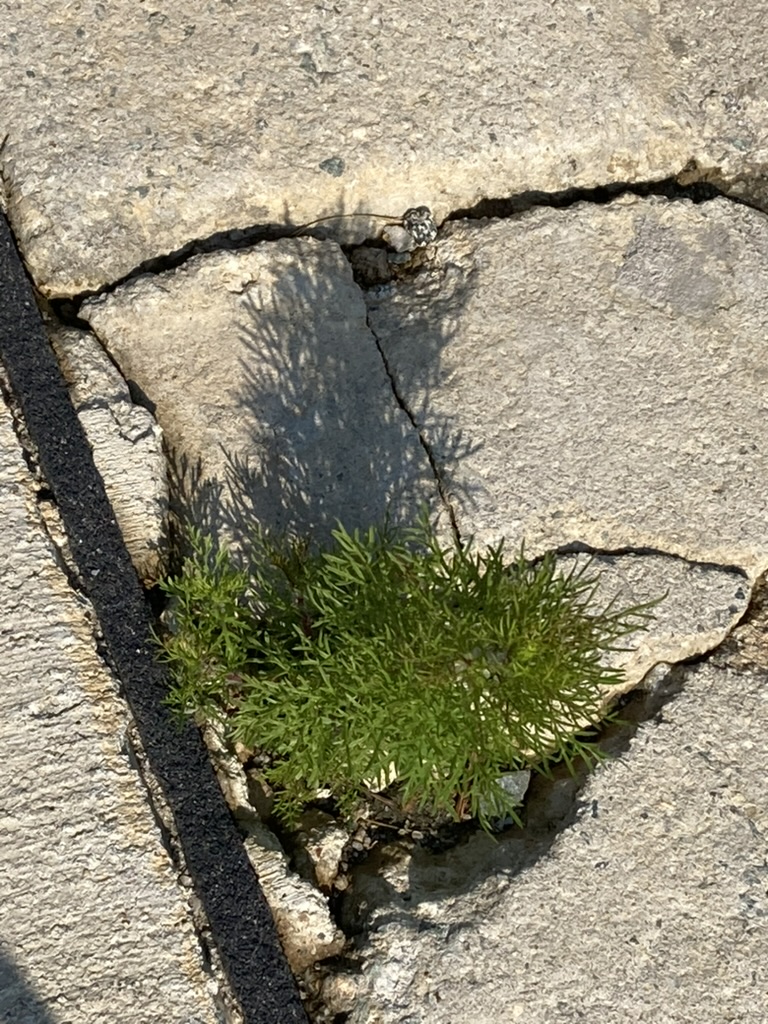
Oh, the importance of cracks! That’s where a seed might find soil to grow or (thank you, Leonard Cohen!) where the light may get into a darkened space, a darkened time. As Cohen councils,

“Ring the bells that still can ring. Forget your perfect offering.”

So here is my imperfect offering.

A large part of my problem has been not knowing what the purpose of this space wants to be. I am — as I’m sure you are too — filled with frustration, rage, and abiding grief at so much that is happening in our world. It seems impossible for me to write without reference to all the on-going destruction on so many levels. We do need to be aware of the negative forces that are rampant, so that we can understand them, resist them, and work towards healing.

There are many ways to begin the healing, even in the midst of the onslaught.

An African proverb reminds us:

The times are urgent.
Slow down.

How am I to begin imagining a better way of being if I am not actually “present” in my own body as it is, if I am not attentive to the small things that compose my current world?

And how will I find strength to move towards the enlivening future I’ve envisioned if I cannot draw energy from the good that –nevertheless — persists here and now, if I cannot find joy in the beauty that exists, if I cannot allow myself delight in a moment?

"The call to slow down works to bring us face to face with the invisible, the hidden, the unremarked, the yet-to-be-resolved. Sometimes, what is the appropriate thing to do is not the effective thing to do."   -- Bayo Akomolafe

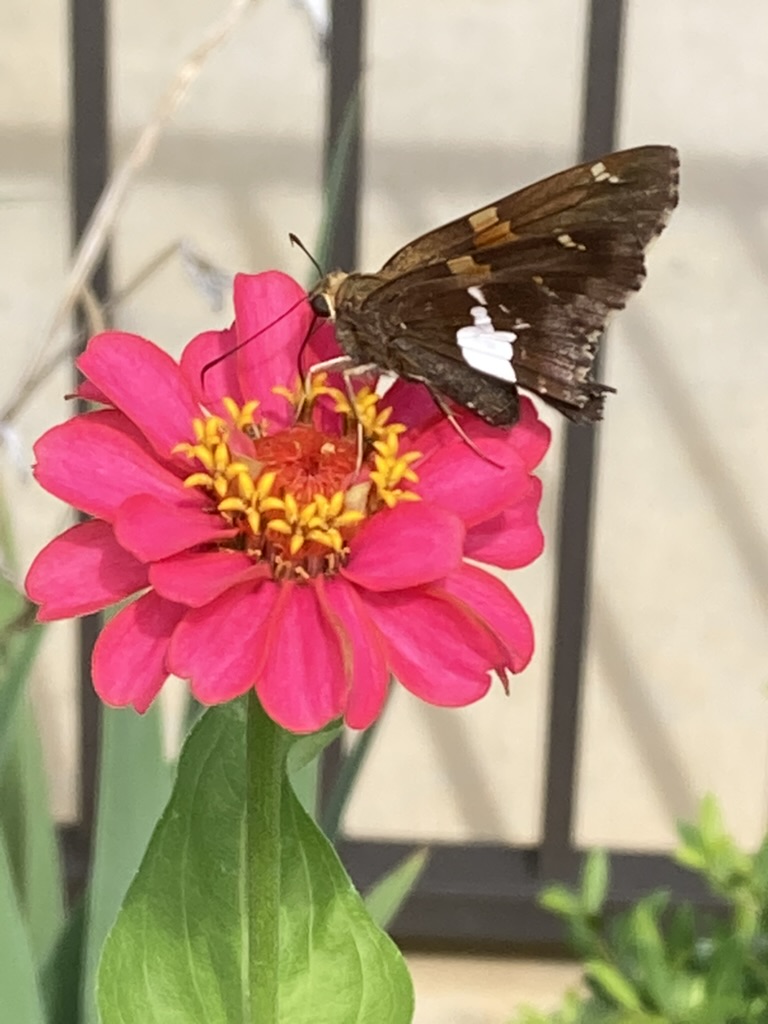
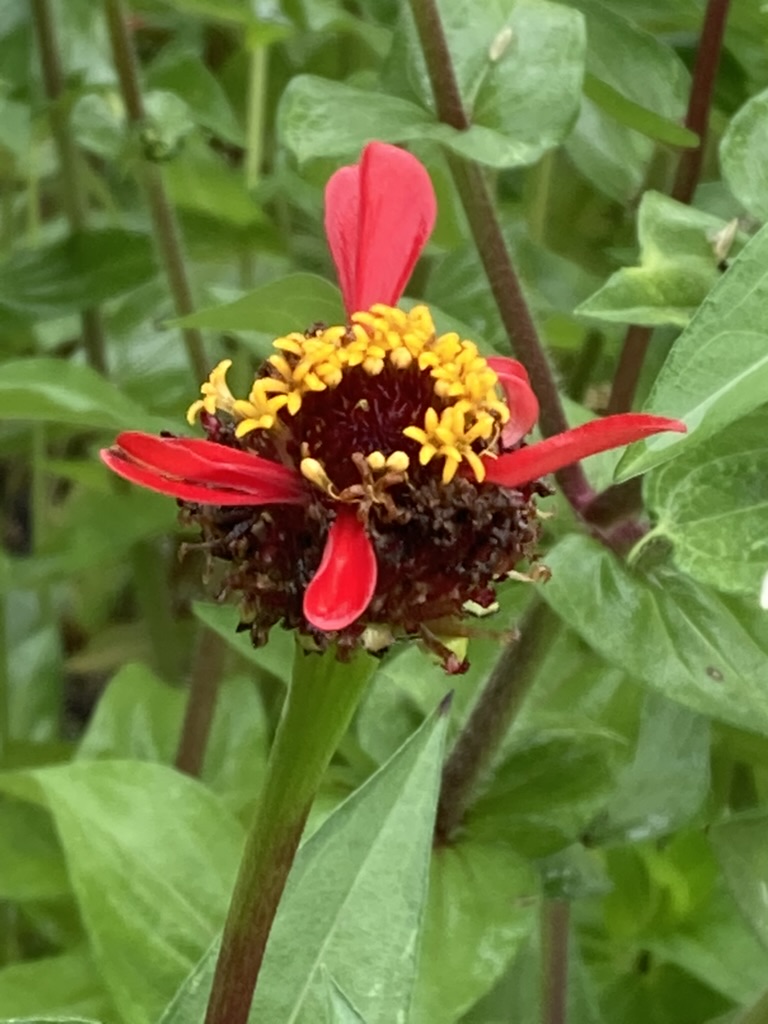
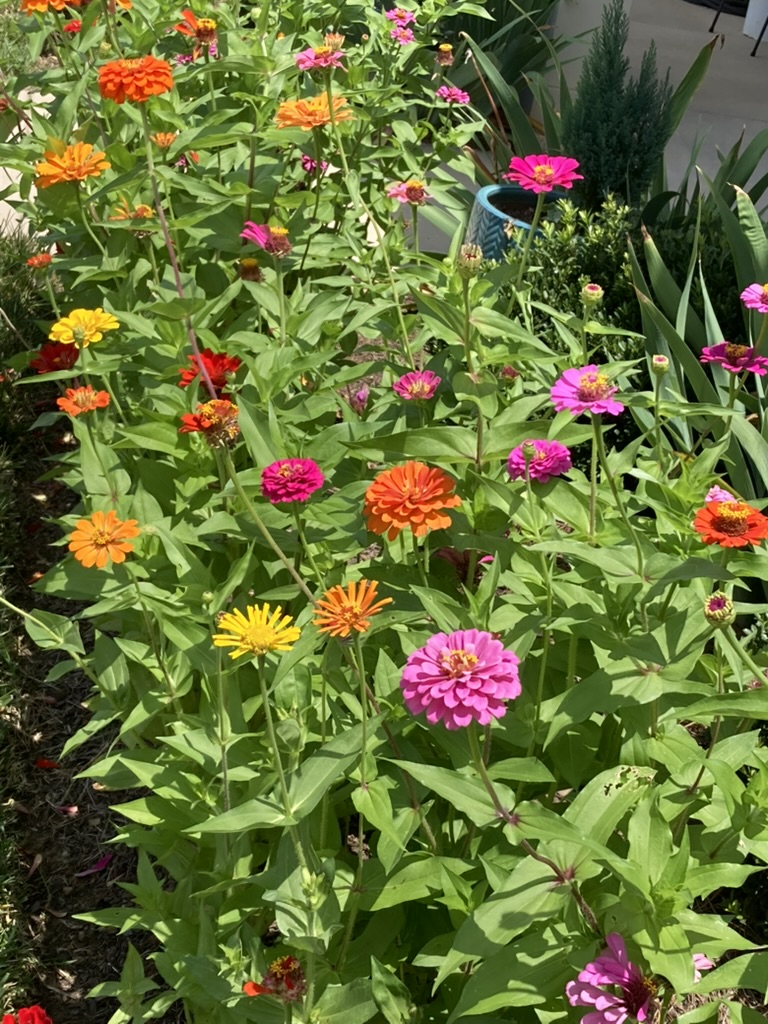
While I ponder Akomolafe’s statement, I’ll continue to find joy in the rowdy colors of summer flowers in my front yard and in those they feed.

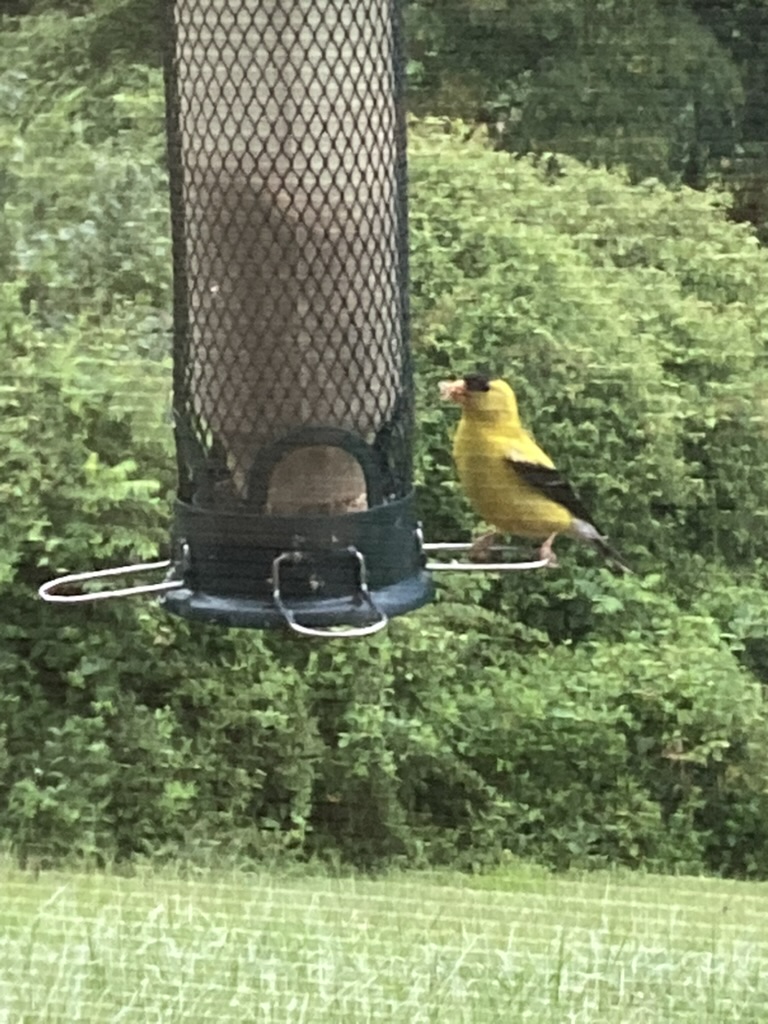
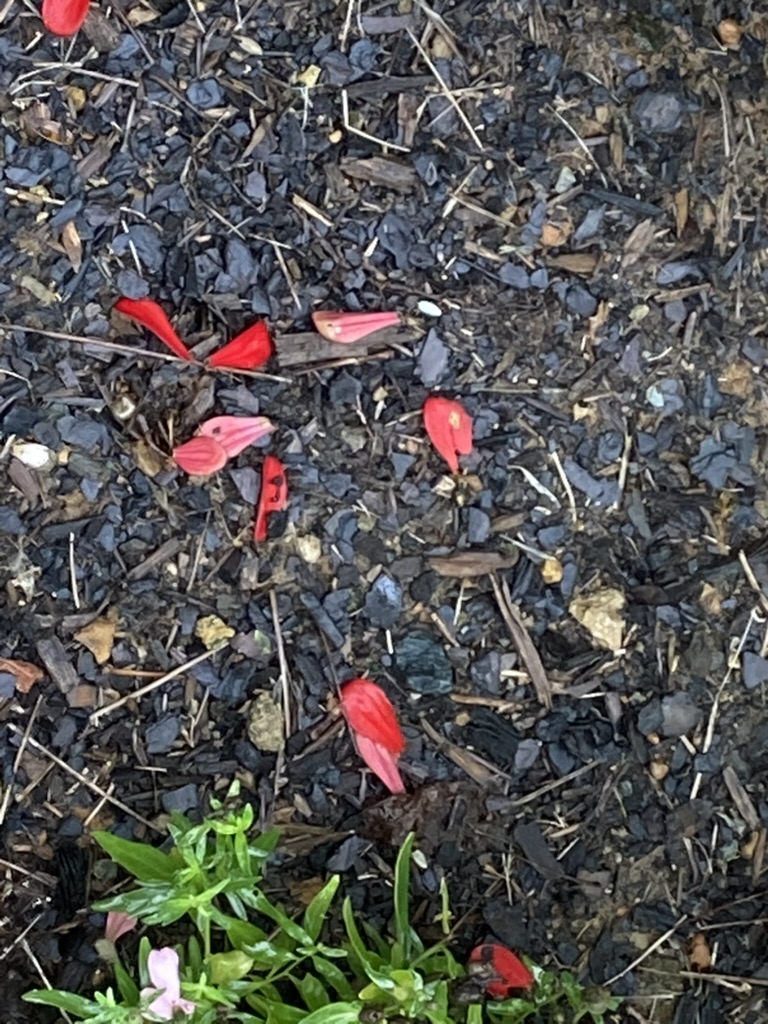
Including, of course, the brilliant goldfinches who forsake the bird feeder to pull petals off the flowers, digging out the seedlets beginning to form beneath.

I can even cut some blossoms for a vase on the table.

There are plenty for everyone, and most of the fun is in the sharing.

Was that a hummingbird I just glimpsed?

A Story for Solstice

Today is Winter Solstice here in the Northern Hemisphere. The sun, which has been moving further and further south for the last six months, appears to pause its journey — seeming to stand still before turning northward once again. Over the millennia, the Winter Solstice has been almost universally considered a sacred time in human cultures, promising the continuation and renewal of light and of life.

I always feel the Winter Solstice viscerally, as if my long ago ancestors were waking in my bones — a potent time of turning, of beginning again. But this year, even as I celebrate the returning light, I see us collectively moving deeper in a darkness of our own making. The dissonance feels like an insoluble koan in which I must rest, from which I must somehow make meaning.

I know, as Padraig O Tuama has written, “You will find meaning where you give meaning. The answer is in a story and the story isn’t finished.”

Do we see ourselves merely as characters in someone else’s Story? Or are we ourselves the ones telling the Story? Either way, the Story takes on a life of its own.

The Nigerian-British writer Ben Okri speaks much about the power of story for good and for ill & I’ve quoted him often here over the years. Here are some fragments from his little book Birds of Heaven which speak to our times:

"Stories can be either bacteria or light: 
they can infect a system, or illuminate a world
."
"To poison a nation, poison its stories. ....
Beware of the story-telllers who are ...irresponsible in the application of their art: they could unwittingly help along the psychic destruction
of their people."

At the moment, we seem to be suffering from a pandemic of cruel stories and outright lies. Where is the medicine we need? It lies in the stories that illuminate and heal rather than hide and destroy. It is vital that we tell and retell those stories.

*******

Here is a story that has been very present to me for the last few months. Certainly the actions in the tale spoke to me strongly as, for week upon week, I wove and un-wove and re-wove and un-wove the tapestry for Faces of the Forest . But, deeper than that, the story is telling me something I need to know about the dark times we are in. Whatever the reason, the story holds me in its fierce embrace & asks that I share it with you.

I first encountered it as told, with a Celtic flavor, by Sharon Blackie . I met it again in November, in Michael Meade’s book Why the World Doesn’t End, and then, if I remember right, most recently in a posting by Sharon Blackie, who mentioned that the story originated with the Lakota people.

I give my deepest gratitude to the Lakota tellers who first opened themselves to the story and whose breath and spirit called it into being. And I give thanks to all the storytellers who have, in their own ways, generously lent their breath and spirits to keep the story alive through the years

*******

Somewhere, just at the edge of the place where you dwell — whether prairie or forest, farm or city, mountain or coast — there is a cave, a cave so well hidden that those who have searched have never found it. And in the cave, two beings dwell in harmony. One is a very old woman, so old that even she doesn’t know how or where she came into being. Her face is beautiful, carved and darkened by the flow of time. And with her there lives a large black dog. He, too, is old beyond knowing. He has always been with her, and she with him

The cave is sparsely furnished. There is only room for a large loom and a fire pit encircled with stones. In the pit, a fire burns, and the fire too is so old that even the old woman doesn’t know who first kindled its flames. Over the pit hangs a large clay pot filled with a stew of berries and herbs and seeds and roots and water from an ancient spring — a delicious soup that simmers and bubbles gently, its sweet aroma drifting now and then out of the cave to touch the lands and waters beyond.

All day and all night the old woman stands at her loom weaving and weaving, making the most beautiful garment of yarns thick and thin, a tapestry of such colors and skill as have never before been seen. As she weaves, the old dog dozes and the soup simmers and the garment grows.

Every now and then, the soup begins to burble and gurgle with such loud energy that it catches the ear of the old woman and wakes the dog. Slowly the old woman turns from her loom and hobbles towards the fire. With a long-handled spoon of horn, she stirs and stirs the soup, making sure it doesn’t burn.

The old black dog watches the old woman as she moves across the cave, and that old dog stands up and walks over to the loom. Quickly he bites and pulls and rips and tears the garment from its loom, then returns quietly to his place.

When the old woman finishes her stirring, she returns to find the loom empty and a heap of shredded and raveled yarns tossed upon the floor of the cave. I don’t know if she sighs but I know she is curious, for she bends down and looks and looks at the chaos of tangled textures and hues. Finally one thread catches her attention, calls to her hands. Smiling, she picks it up and begins to weave a new garment. It is a tapestry shimmering with skill and magic, perhaps even more beautiful than the last. And so she weaves and weaves, always listening to the song of the soup; and when it is time, she turns to stir.

I don’t know if this is exactly how it happens, but I know that it is true.

*******

Ben Okri says, “In bad stories words cancel themselves out, and nothing is left. The words return to the source; they desert the page; only meaningless marks are left behind. …. Stories are always a form of resistance. …. The true story-teller suffers the chaos and the madness, the nightmare — resolves it all, sees it clearly, and guides you surely through the fragmentation and the shifting world.”

Let us resolve to tell only good stories, stories that, like the returning sun, illuminate and enliven.

*******

And please forgive me for posting yet again, my old, old poem. It is, as always, my prayer for the Winter Solstice — perhaps now more than ever.

             Turning

Now the earth slides faster down
the long dark days towards Solstice.
We’ve been flung
almost too far from the center,
skidding violently along
the curve of space.

The pace
presses me flat against the rocks,
among the dried debris of summer.
Blackberry canes snarl my hair;
faded petals or leaves,
compressed beyond recognition,
cling to my lips and eyes.

Oh, it’s a long slide
down to the Solstice.

But we
shall be
tugged sunward at last on gravity’s leash:
a cosmic
crack-the-whip.

We’ll hit the corner flying
and careen round into who knows
what great wind of passage.

Even I
may be blown clear out of this cave, clean
onto my feet.

Lifting my arms to
layer upon layer of translucent
color cupped to Earth’s curve,
I’ll feel the thrust of the planet
beneath my feet.
Gulping air straight
from Arctic floes,
I’ll raise my face to
the icy stab of Orion’s sword and
roar
for joy.

— MCK

Heart-Fire

In the library last week I spotted a book of Mary Oliver’s poems with which I was not familiar. I picked it up, opened it randomly, and found this poem.

HEART POEM by Mary Oliver

My heart, that used to pump along so pleasantly,
has come now to a different sort of music.

There is someone inside those red walls, irritated
and even, occasionally, irrational.

Years ago I was part of an orchestra; our conductor
was a wild man.  He was forever rapping the music-
stand for silence.  Then he would call out some
correction and we would begin again.

Now again it is a wild man.

I remember the music shattering, and our desperate
attentiveness.

Once he flung the baton over our heads and into
the midst of the players.  It flew over the violins
and landed next to a bass fiddle.  It flopped to the 
floor.  What silence!  The someone picked it up
and it was passed forward back to him.  He rapped
the stand and raised his arms.  Then we all breathed
again, and the music restarted.

I had to smile. What a beautiful description!!!

The local cardiologists, surgeons, and electrophysiologists have all conferred & told me that there is nothing more that they can do to help my heart. They did, however, enthusiastically suggest that, since the leakage in my tricuspid valve is “torrential,” I might be a good candidate for participation in a research trial involving a new procedure developed by Abbott Labs. One of the trials is being held in a large medical facility only an hour and a half away, so they sent off my records & I settled down to wait for a response, wondering, hoping. At length, the doctor running the trial called me down to Charlotte for yet another echo-cardiogram & a clear, enthusiastic,and quite fascinating explanation of the procedure. The doctor said that one trial had just been completed elsewhere with exciting results and that “You’ll be reading about it!” [And sure enough — yesterday (3/5) the NY Times had a long article describing the symptoms and the trial’s excellent results: https://www.nytimes.com/2023/03/04/health/tricuspid-valve-clip-leakage.html ]

I was told that during the next few days, the research team would meet to discuss my case & by the end of the week they’d call back with a schedule of tests needed before the procedure.

Indeed, a call came, not to offer a schedule but to set up an appointment to talk with the doctor. I knew then what to expect. Every time a doctor talks to me, the first sentence is “You know your case is very complicated.” The ensuing conversation with this doctor began the same way. The team didn’t think they could successfully carry out the procedure on my heart and, even if they managed to do it, they thought that — given all my other heart & lung complications — it probably wouldn’t make much difference anyway. So…. a dead-end.

Well, I’m telling you this long story only because of the surprising (to me) and wonderful, joyful outcome — truly old Trickster teaching me his famous side-step! Somehow I feel liberated! No longer wasting energy considering possible remedies, various strategies, what-ifs & hopes, I feel free to just accept, with gratitude, that this is how it is going to go for me & to get on with finding ways to live my life as meaningfully as possible anyway. Every life has its constraints. These are mine. So what?

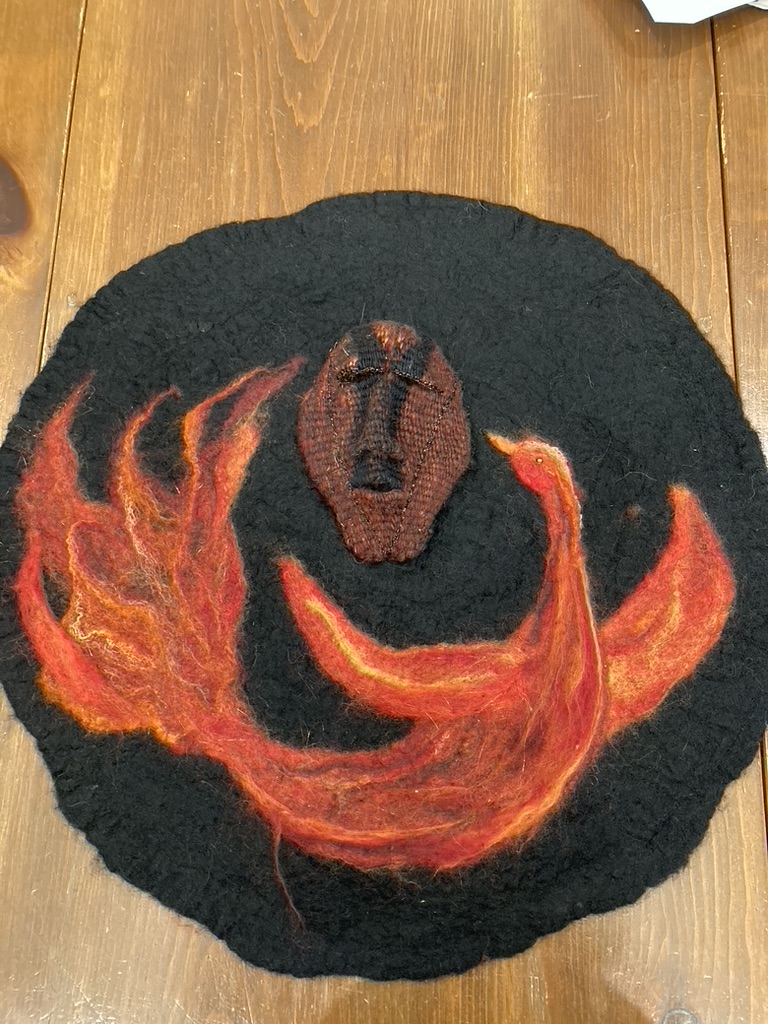
Acknowledgement & acceptance have led to a wonderful increase in — or reclamation of — my inner Fire. This has helped me finish a project that had been languishing or, at best, proceeding very, very s-l-o-w-l-y for months. Somehow, my conversations with the fibers must have continued to simmer in some hidden inner cauldron. Now the embers rekindled & flamed and the cooking began in earnest. I began to show up more regularly in my work/play room & my conversation with the fibers began to flow again. The completion has (as always) hit some snags & included some tedious bits but, once I started to work again, the impetus — the Fire — stopped faltering & grew.

This past year, I have heard 3 different Slavic stories of the beautiful magical Firebird [not to be confused with the Persian Phoenix who rises from her own ashes]. I told one of the stories in my 9/23/22 post.

These stories have enchanted and evoked some deep resonance within me. Encounters with the Firebird are never simple. Always the finding of a Firebird feather signals the beginning of a difficult adventure that leads one deeper into one’s true self. The adventure usually involves a tsar demanding (with the threat of death) that one capture the Firebird, the delivery of the Firebird to the tsar, and then the freeing the Firebird at last. The Firebird is elusive and wild. Those in power seek to cage it for themselves, but always it must be, will be, freed — just like the Fire within ourselves. And just as the Firebird is wild so, too, in the required series of tasks & adventures, the “hero” requires help from an animal (a talking horse or big gray wolf in the stories I heard). No rule book could provide the necessary map & answers nor could his own human rationality, but Wildness itself showed the way. There is much here for me to learn.

Touched by the Firebird

*****

[On a larger-than-personal level, my shift is a bit like finally having realized that we are, in fact, already in the midst of the disasters (ecological, political, economic, technological, etc.) that we have struggled for so long to prevent, hoping we could somehow stave them off and return to what we’d thought of as “normal.” Our need to act remains, but — recognizing that deep & irreversible changes have already taken place — can we channel more of our emotional energy away from fear or ranting or trying futilely to “stand our ground” when that ground has already become shifting windblown sand dunes? Can we focus our energy not on so much “combat” as on creative responses to the evolving situation? I believe that, in spite of everything, we can uphold our gratitude & reverence for all life and “remember who we are and how we got here, accept the inevitable, honor our grief, and prioritize what is  pro-future and soul-nourishing.” We can live “meaningfully,  compassionately, and courageously no matter what.” (Quotes from https://postdoom.com/ ) ]

“Sometimes I go about pitying myself. All the time I am being carried on great winds across the sky.”

Chippewa Song

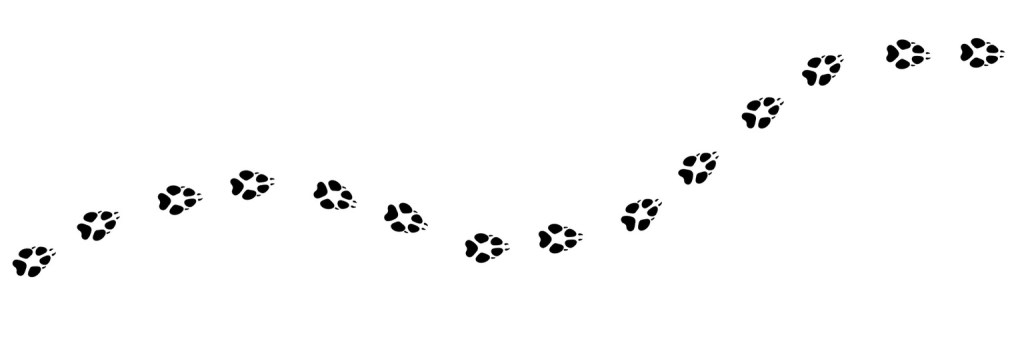
Trickster’s Tracks

Looking back over the last week or so — no matter what the topic or level of experience & meaning — I see Trickster’s tracks weaving in and out and over my own tracks, sometimes almost obliterating them. I feel flummoxed and frustrated and have wanted to raise a fist & shout “Enough Already!” …..But, of course, it isn’t enough; otherwise he’d skip away to other business. Trickster is summoned into existence by many things — inattention, indecision, distraction, lack of perception & imbalance, and hyper-seriousness, to name just a few. They all seem to describe the sort of funk I’ve been in. Trickster is my eternal teacher, usually advising me to praise paradox more loudly & to dance through this journey more lightly, more joyfully.

*********

– – – – – – And, since writing those words yesterday, since naming Trickster’s message, I’ve found myself turning a corner, choosing a path, no longer stuck in indecision and useless lamentation at the crossroads. I continue to be amazed by the power of words. Preoccupation with words — or with a lack of them — may occasionally cause me to stumble into some deep crevasse … but words can also provide the handholds & footholds I need to climb back out and continue the journey!

Of course, many feelings and experiences are way beyond words & need to be protected from attempts to nail them down & cage them with language. Trickster himself is one of those beings/experiences. This is why poetry, metaphor, story are the linguistic vehicles we use when trying to share the deepest truths. And there are non-linguistic ways as well — image, music, dance….

I love nonverbal communication. Still, words are strong — and, like Story, potentially dangerous. Many indigenous cultures (including the Navajo and the ancient Hebrews) have taken language seriously, recognizing that spoken words create or shift reality. For me, writing, saying, or just thinking a word, metaphor, or story can sometimes be a prayer, both a source of clarification & a kind of commitment. Such commitment is essential before undertaking true work. (My teacher Luisah Teisch teaches that Trickster sits at the Crossroads and, if you lack clear intention & commitment, he is more than happy to lead you astray.)

William Hutchinson Murray (1913-1996), Scottish mountaineer & writer, reminds us:

“Until one is committed, there is hesitancy, the chance to draw back. Concerning all acts of initiative (and creation), there is one elementary truth, the ignorance of which kills countless ideas and splendid plans: that the moment one definitely commits oneself, then Providence moves too. All sorts of things occur to help one that would never otherwise have occurred. A whole stream of events issues from the decision, raising in one’s favor all manner of unforeseen incidents and meetings and material assistance, which no man could have dreamed would have come his way. Whatever you can do, or dream you can do, begin it. Boldness has genius, power, and magic in it. Begin it now.”

And so I am, once more, beginning — remembering the words of St. Benedict:

“Always we begin again.”

I have finally begun to put into words for myself a paradox that, especially in light of political struggles here in the U.S. & around the world, has been drifting in a cloud around me like a swarm of gnats, bothering me incessantly. Somewhere earlier on this blog I said (no doubt, many times) that the power of Story is stronger than we’ve imagined and can be harnessed for healing or for harm. But when I read definitions of Story, I hear little that distinguishes these 2 possibilities from each other, little to explain the difference and how to identify & avoid or overcome the latter. Why/how is one story “better” or more “true” than another? After wallowing unhappily in my puzzlement for far too long, I feel like someone who’s been drowning in shallow water and suddenly — simply — puts her feet down on the bottom and rises up above the waves. [This reminds me of the saying — highlighting the stunted growth of trees in the cold of Iceland — that advises: “If you are lost in a forest in Iceland, stand up!”]

Well, more on those thoughts as they develop….

I’ve also been dithering for weeks about the colors for my next weaving. As I’ve pulled out more & more possible (or impossible) fibers and yarns from my stash, my studio came to resemble the messy, unstructured, hodge-podge nest of a mourning dove — though the mourning dove is definitely more minimalist than I am in the collection of building materials. (I once read about a mourning dove who constructed her nest of just five poorly arranged twigs.)

Two days ago, I came across words written by Maeve Brenan to her friend Tillie Olsen:

“You are all your work has. It has nobody else and never had anybody else. If you deny it hands and a voice, it will continue as it is, alive, but speechless and without hands. You know it has eyes and can see you, and you know how hopefully it watches you.”

Hooray for synchronicity & serendipity! This was just the reminder, the wake-up call, I needed. “... and you know how hopefully it watches you.” How much longer will the work be patient? There have been times when, faced with my endless wavering, it finally gave up on me and went off to look for someone else.

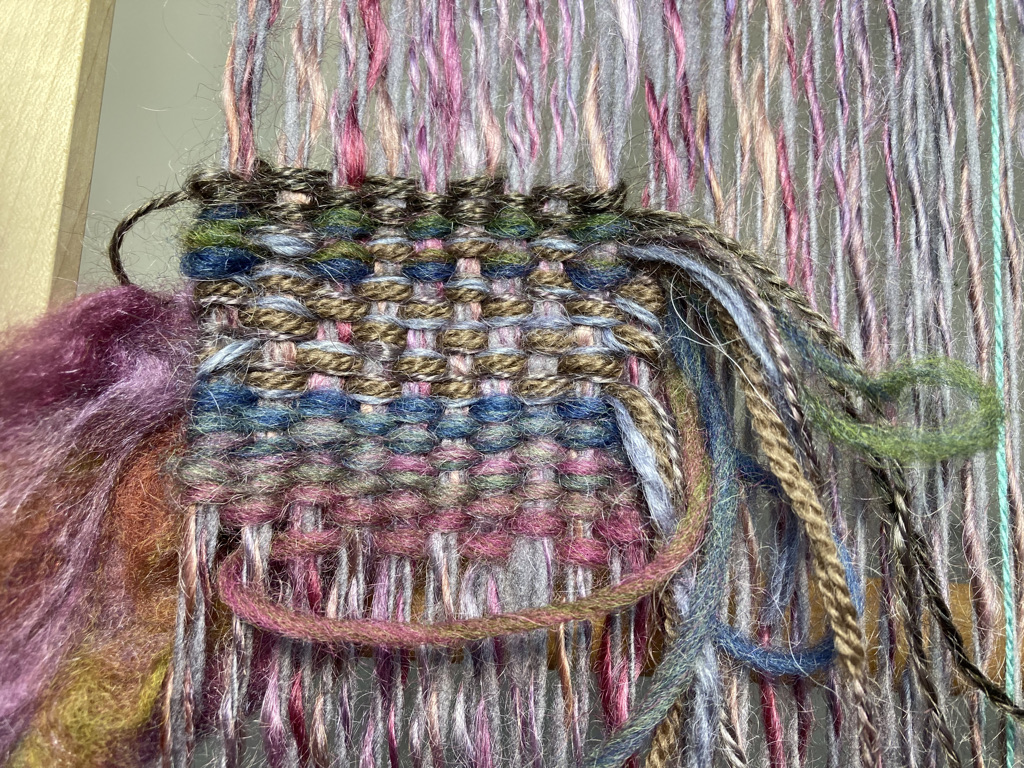
So — I finally pulled out some fluffy gray wool & slick hand-dyed mohair and began to spin yarn for the mask’s warp (which will become the hair). Yesterday I plied the two uneven yarns together loosely & washed the skein to set the twist. …… Ha! The power of commitment took hold! When I couldn’t sleep last night, I got up & found the yarn to be dry. I cut the lengths and warped the loom — and returned to bed for a few hours of satisfied & restful sleep. First thing this morning, I began playing with a variety of wefts on the edge of the warp, anxious to see some of the possibilities emerge before unraveling them all & beginning to weave the form in earnest. (Warp colors are not bright pastel than shown — more subdued & subtle.)

Throw Yourself Like Seed ~~ by Miguel de Unamuno

“Shake off this sadness, and recover your spirit;
sluggish you will never see the wheel of fate
that brushes your heel as it turns going by,
the man who wants to live is the man in whom life is abundant.

Now you are only giving food to that final pain
which is slowly winding you in the nets of death,
but to live is to work, and the only thing which lasts
is the work; start then, turn to the work.

Throw yourself like seed as you walk, and into your own field,
don’t turn your face for that would be to turn it to death,
and do not let the past weigh down your motion.

Leave what’s alive in the furrow, what’s dead in yourself,
for life does not move in the same way as a group of clouds;
from your work you will be able one day to gather yourself.” 

************

In the meantime, the other-than-human world continues to offer its multiplicity of gifts. A Yellow-crowned Night-Heron has visited the neighboring pond (drained during a construction project but now refilling) a number of times this week — Such a magical creature!

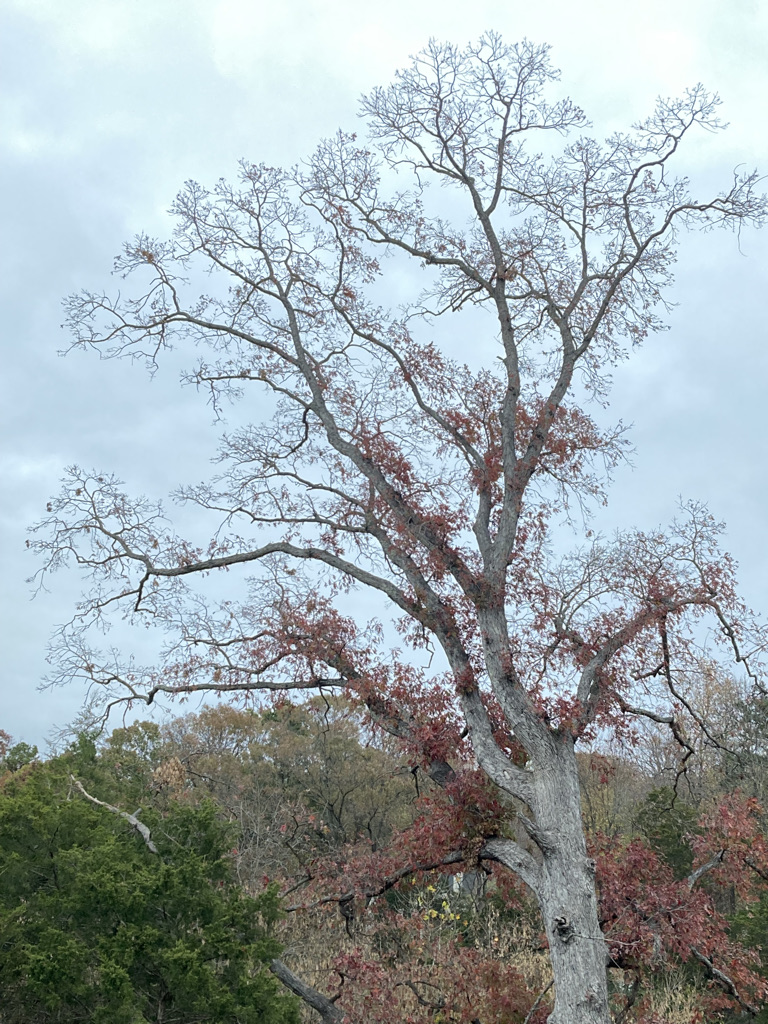
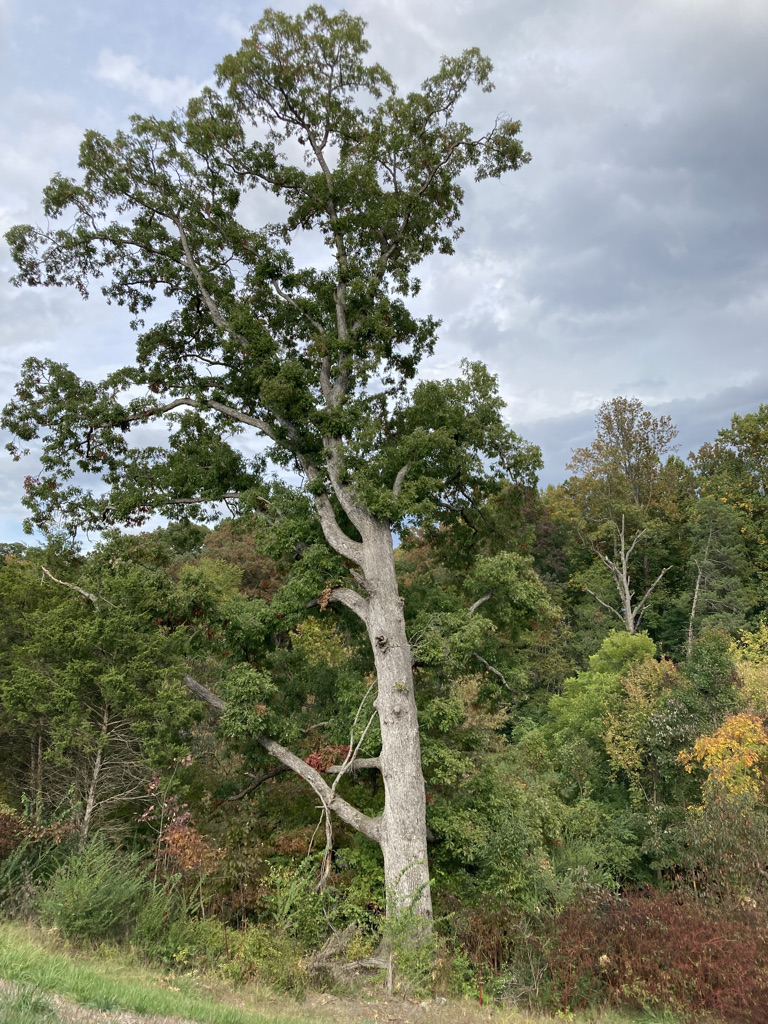
And Old Oak continues to shed leaves & let go of overt growth so that she can find a deeper life in the darkness of winter — a time when, though the part of her I see above ground will appear dead & dormant, deep underground her roots will continue to grow & to gather water and nutrients — storing them to propel her sudden burst of life in the spring.

I love how her bones are beginning to show: the form, the strength, the scaffolding on which her life and the lives of many other beings depend.

Of what am I currently letting go? 
What is the shape of my own scaffolding? 
And what, I wonder, will my roots be doing this winter?

In the meantime, I’ll leave us all to ponder the advice of Osho:

"Don't move the way fear makes you move.
Move the way love makes you move.
Move the way joy makes you move."

Trickster Times

Hello, dear ones. My body has been out of balance all week, so I’m officially giving myself a “leave of absence” for this week. [Can bloggers do that???] However, I do want to share the words of others that have been rattling insistently around in me.

The first is a beloved statement by Ben Okri that I’ve shared before:

“The earliest storytellers were magi, seers, bards, griots, shamans. They were, it would seem, as old as time, and as terrifying to gaze upon as the mysteries with which they wrestled. They wrestled with mysteries and transformed them into myths which coded the world and helped the community to live through one more darkness, with eyes wide open and hearts set alight.”

”And I think that now, in our age, in the mid-ocean of our days, with certainties collapsing around us, and with no beliefs by which to steer our way through the dark descending nights ahead — I think that now we need those fictional old bards and fearless storytellers, those seers. We need their magic, their courage, their love, and their fire more than ever before. It is precisely in a fractured, broken age that we need mystery and a reawoken sense of wonder. We need them to be whole again.”

– Ben Okri

The next quotes are from Sharon Blackie’s remarkable new book Hagitude (pp. 188-189 & pp.193-196), which I am currently in the midst of reading. (I expect more references to this book will come along — She has much to say about the Old Woman in myth & story, including Trickster aspects & the role of the fiber arts in old stories.)

Writing about the work of René Guénon (Symbols of Sacred Science, 1962), Dr. Blackie says Guénon

“… argued that we now live in ‘degenerate times,’ at the end of a long era during which important spiritual truths have been forgotten, the ancient centres of wisdom have been destroyed, and the guardians of that wisdom are long gone. However, he suggested, the safest repository for such old truths has always been folklore. He believed that knowledge which is in danger of being lost can be translated into the symbolic code of a folk tale, and then passed on through the storytelling tradition. [….] Then, in better times, people might once again appear who understand the code, and who will penetrate the symbolic disguise and uncover the wider meaning behind. … It’s incumbent on us to tell the old stories — and to use those stories, when necessary, to hold the culture to acount.”

Later, Dr. Blackie describes Trickster beautifully:

“…Trickster is above all a disruptor of the established order, upsetting it so that necessary change might come about. Trickster happens along when something urgently needs to shift, sweeping out the old, arid and useless to make way for the new.”

“…Trickster holds up a mirror to all that is dysfunctional, hypocritical and perverse in us or in our culture, and challenges our deepest assumptions about our own nature, or the nature of the world around us.”

“The Trickster, then, in all her [or his] diverse forms, is the character who breezes in and breaks something in an attempt to wake us up, revealing to us the shakier truth which underlies a seemingly stable situation. And so Trickster can also be thought of as an archetype of the apocalypse — in the original sense of that Greek word, which means revelation: [quoting Richard Goswiller] ‘an unveiling or unfolding of things not previously known and which could not be known apart from the unveiling’.”

“What follows after Trickster’s intervention, of course, depends on many things — among them, the specific qualities of the Trickster who happens along in the story we are living through. And although we don’t always get the Trickster we imagine we might want, we mostly get the Trickster we deserve….”

It seems to me that we are really in the midst of major Trickster times on a global scale. Certainly we’re having to face “all that is dysfunctional, hypocritical and perverse in us or in our culture” & are being fiercely challenged on some of our “deepest assumptions about our own nature, or the nature of the world around us.” What do you & I see when we look in Trickster’s Mirror? And how & which of the old Stories can be of help? What & how am I (are we) telling stories? …These aren’t just “rhetorical questions.” I’m really pondering all this, thinking of my actions.

Anyway, I have to smile as I frequently repeat to myself what the Hunter’s Horse said in the story posted Sept. 23 : “Fear not — the worst is yet to come.” Don’t fear, don’t weep, the Horse says again & again. Step into the next part of the Story & deal with what you find. You might be surprised!

And, of course, we’re not alone. The Earth community in all its embodied forms is speaking to us all the time. Nowadays birds & deer are bringing me Stories. The Old Tree behind our house (or, I should say — in front of which our house has been planted) teaches me & shares her Stories every day. Who else is telling the Stories I/we need to hear? What are the Stories that need to be shared — in language and in a myriad of other ways? How does my fiber work speak? Much to contemplate…. and then to embody, to enact as a participant in this on-going story.

The Old One –10/13/2022

Thinking of Edges

I’ve been having trouble placing the 2 masks on the context I showed last week. Finally I’ve realized that the problem is that the masks didn’t want to be placed on the land, but wanted to emerge from the land.

I did a couple small samples to figure out how that could happen. The best way is to place, before felting, a resist under the top layer in the area where the mask will emerge. After felting, the area above the resist can be opened so the mask can go beneath the surface to rest on the separately-felted space below. Then parts of the separated surface layer can be needle-felted onto the mask so that it is an integral part of its context. In the case of my current making, the context has already been thoroughly felted — too late for that solution!

It is possible to simply cut out a mask-shaped hole, put in the mask, and needle-felt some more fibers like those in the surface layer to join the mask to its context. But that cutting of a hole seemed to violate the idea of “emergence” — and besides, in the current case, I don’t have enough of the context fiber left to do a good job of hiding the separation between mask & context.

So — for now — a pause on this piece……….

And — for future explorations/makings — some exciting new possibilities!

All this work has set me to thinking once again about “edges” and “boundaries,” about how things can be separate but also part of a whole, about Trickster the boundary-crosser, and about permeability & liminality.

I’ve thought about what the living world teaches us about Edges. The amazing diversity that exists at Edges — for example, the teeming life of intertidal zones or the cultural richness and cross-fertilization found at gatherings such as those along the Silk Road.

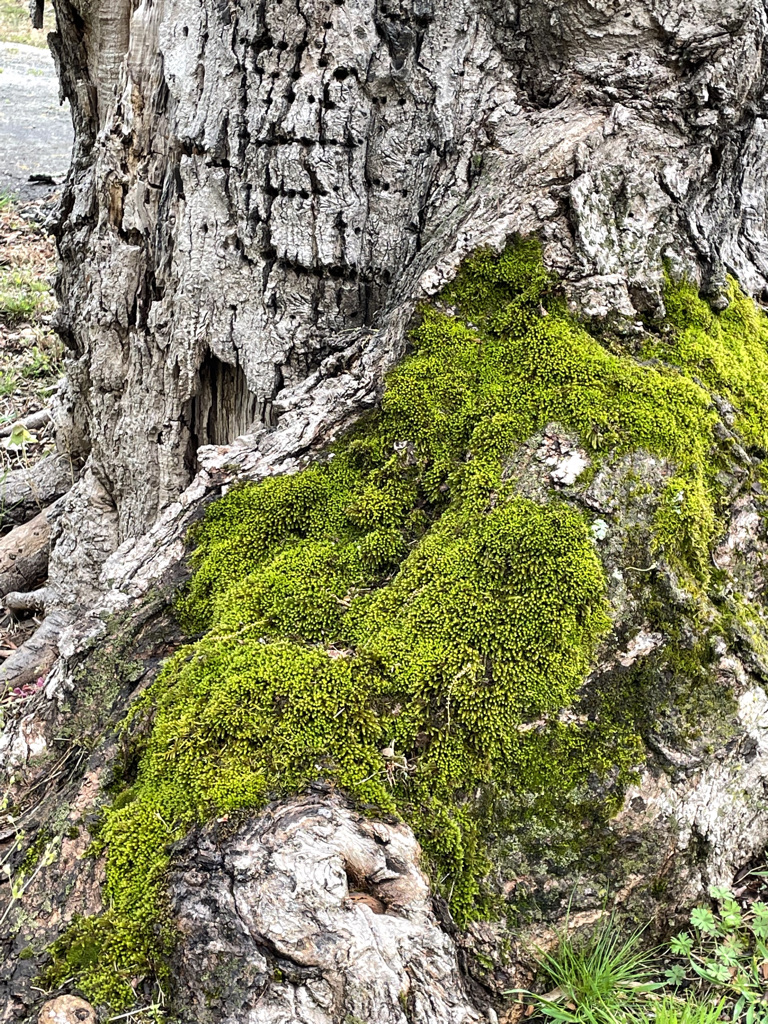
Fungi, lichen, and moss are all wonderful creatures of edges and transitional zones. Mosses fascinate me both with their beauty and with their special adaptions to the boundary layer between air & land. [Do read Robin Wall Kimmerer’s lovely book Gathering Moss for much, much more!]

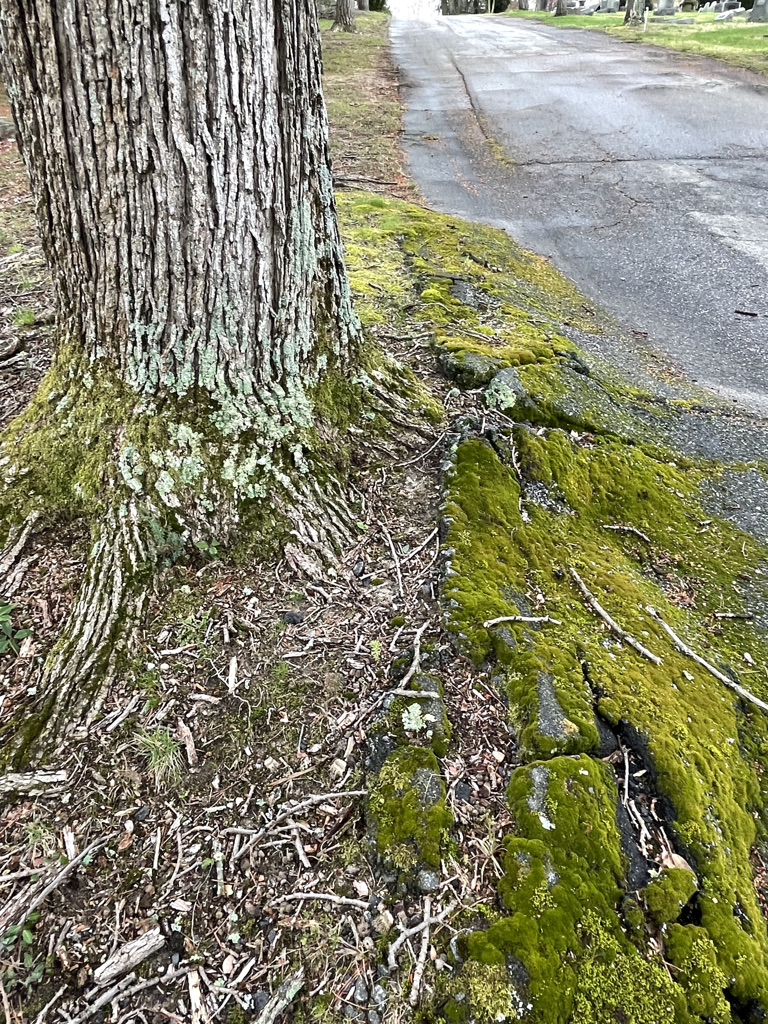
I see this, and several similar areas, every day on one of my walks — a wonderful meditation on Edges & Emergence & the power of Community.

Tree roots pushing aside the asphalt. Lichens & mosses making homes both on the bark of that tree and on the asphalt it has broken. Together, the mosses begin to create new humus with nutrition for more forms of life. If there is no interference, the arbitrary asphalt will once again join the larger, living land.

In the Coyote story I told May 6, No Song lived at the extreme edges of his village. It was there that he met Coyote — the primordial Edge dweller, transformer, holder of liminal space — who gave him a Song. But when the newly-named Sings Wonderfully was pulled too much away from the Edges (where, for example, rituals dwell) and back into the center of cultural hustle-bustle and self-aggrandizement, Coyote took his Song away.

Edges & transitional zones can places of nourishment, growth, and inspiration.

“I think we could make a case that most of the world’s great religions, philosophies, artforms, even political systems and ideologies were initiated by marginal figures. There is a reason for that: sometimes you have to go to the edges to get some perspective on the turmoil at the heart of things. Doing so is not an abnegation of public responsibility: it is a form of it. In the old stories, people from the edges of things brought ideas and understandings from the forest back in to the kingdom which the kingdom could not generate by itself.”

— Martin Shaw, storyteller

I’ve been thinking about what Shaw’s words mean in terms of the stories and art and imagining we need now in these times of political/cultural & environmental upheaval……

…. Also wondering how often I really listen deeply to what the Earth is saying…

*******

If you’d like an exuberant reminder of how we can listen to Earth, here’s a joyful, rollicking song/chant & affirmation:

Put Your Roots Down — Thrive Choir

Coyote Speaks

Coyote (and all Trickster energy) speaks to us in so many ways, at so many moments. Sometimes, Coyote speaks with words, sometimes with actions, sometimes through pure synchronicity.

I am a participant in the Mythic Imagination Community convened by Dr. Sharon Blackie, sharonblackie.net/ . It is a lively group & I have thoroughly enjoyed the many opportunities to hear, consider, and discuss stories from many sources. Last week I wrote to you about my falling out of right relationship with the materials, tools, and process with which I was engaged in weaving a new mask. Imagine my delight when, in an on-line gathering, the storyteller Audrey di Mola told a story that totally explained the dilemma into which I’d stumbled. Audrey does not pre-plan the stories she will tell, but listens & listens to hear which ones want to be told in that particular moment, to the particular ones who have gathered. So I found it stunning that she began with this Coyote tale. Like all stories, this one has traveled, but it probably originated [if stories really ever have a point of origin….?] among the Paiute who have traditionally lived in the Great Basin area of what is now the western U.S.

As always, I give gratitude to the first tellers and to all the tellers who have gone before me, keeping this story alive with their heart-felt breath. This is my telling for this moment, recognizing that writing is not the same as speaking but is still an act of homage to the story itself. And I don’t know if this is exactly how it happened, but I know it is true!

*******

In that time that is before time and outside of time and right now, there was a village. And the people of that village gathered together in ceremonies where everyone offered their own gift of song to weave the community together. There were long songs, short songs, fast and slow songs — and each was beautiful and each was offered as a gift to all.

But in that village, there was one man who had no song to offer to the gatherings. He hung around the edges of the village, silent at the time of ceremony & offering, and the villagers named him No Song.

As time passed, No Song spent more hours, then days, then weeks away from the village, wandering in the great forest beyond. As he wandered, he began to learn the plants in all their kinds & the animals in all their different kinds. With respect for all the plant people, No Song wove a basket & began to gather herbs. With respect for all the animal people, he took up a bow and began to hunt. And his skills grew.

One day, No Song decided to make a stew of all the abundance he had gathered. He stirred and stirred, adding herbs and grains and meat to the pot in a skillful way, so that soon a wonderful aroma began to arise from this cooking and floated off through the forest.

After awhile, No Song looked up from his stirring. And who should he see leaning against a nearby tree, but that Old Man Coyote — and Coyote’s nose was twitching as he inhaled that delicious aroma.

“Oh,” said Coyote,”oh, that stew smells so good & I am so hungry. Please, will you give me the stew?”

No Song thought & Coyote watched him thinking. Finally, No Song said, “Yes, I can give you a bowl of stew.”

“Not enough!” replied Coyote. “I am so hungry & that stew smells so delicious — I want the whole thing!”

No Song thought & once again Coyote watched him thinking, and Coyote thought too. “I know,” said Coyote, “we will make a bargain. You give me all your stew & I will give you your heart’s desire.”

No Song’s eyes grew large. He felt hope swell in his heart. “Can you give me a beautiful song? a song I can offer in the village ceremonies? the most beautiful song?”

Coyote nodded. “No problem. I can give you the most beautiful song in the world. But,” he added as No Song began to jump for joy, “there is a 2nd part to the bargain. You must sing your song only at the right times, in the right places, in the right way — or I will take it away.”

No Song was so excited, he didn’t even need to stop & think. “Of course,” he said. “Of course, I would never ever think of singing my song at the wrong time, in the wrong place, in a wrong way! Never ever! I’m sure! Now the stew is all yours & you give me my Song!”

Coyote stepped forward and, with a huge slurp, he swallowed all the stew. Then Coyote stuck his head right into that pot and licked round & round. And as soon as that pot was was really and truly empty, Coyote vanished.

It all happened so fast, before No Song could say a word. No Song opened his mouth to call after Coyote — and out came a Song, an amazing song, a song that was as enchanting as the birds’ chorus on a spring dawn, that was a radiant as the rising sun & as lustrous as a full moon, that contained all the sounds of the forest on a gentle day, and even the roar of a stormy wind. It was, indeed, a beautiful song. And No Song started back toward the village.

When he arrived at last, No Song found that a ceremony had begun in the center of the village, a ceremony in which all the villagers were singing their songs for the weaving of community & the healing of the world. At first, No Song hung back at the edges as was his way. But as he listened to the songs rising and falling to bless the gathering & to bless all the Earth, his heart filled & he stepped forward and opened his mouth to sing.

Everyone turned. They could scarcely believe what they heard & saw — there was No Song singing a Song & not just any song, but a Song that seemed to gather together the hearts of all the villagers and of all the animal & plant & rock people in the surrounding forest. No Song sang & sang. “Again,” cried the villagers, and No Song sang again. And again.

And when the ceremony was completed, everyone gathered around No Song — talking all at once, telling him what a wonderful Song he had, asking him if he could sing it here, there, everywhere. They renamed him Sings Wonderfully. Overwhelmed by their attention, he promised to sing for them whenever they were having a family celebration or a feast or just to pass the hours of a long dark winter’s night. And so he did. He traveled around singing the Song, smiling at the praise.

Then, one night — when Sings Wonderfully was getting ready to sing for a rather rowdy party — he looked out at the crowd and saw, leaning against a tree just outside the circle of firelight, Old Man Coyote. “Hello,” cried Sings Wonderfully, “I’m so glad you came to hear me sing!” Coyote just shrugged his shoulders and shook his head. “Well, I see you have forgotten…” Then Coyote melted away into the crowd, and when Sings Wonderfully opened his mouth to begin ….. the Song was gone.

*******

Make of this telling what you will...
Could it be that stories may not have either beginnings or endings?
How does this story speak to you as you hear it now?  
And even more,
as the storyteller Martin Shaw often asks his listeners, what will you do with it?

In the meantime, my dance with fiber & with Trickster continues. More than once I’ve wanted to make a dash to the yarn store to see if I could find a “perfect solution” to whatever issue of color or texture has arisen. But I decided at the start to use only the fibers & yarns I had on hand. That’s how Trickster works, incorporating whatever comes to hand in some marvelous feat of bricolage as he makes the world. And isn’t that how cosmological, geological, and biological evolution work, too — just trying out might be done with whatever is around in the circumstance of that moment?

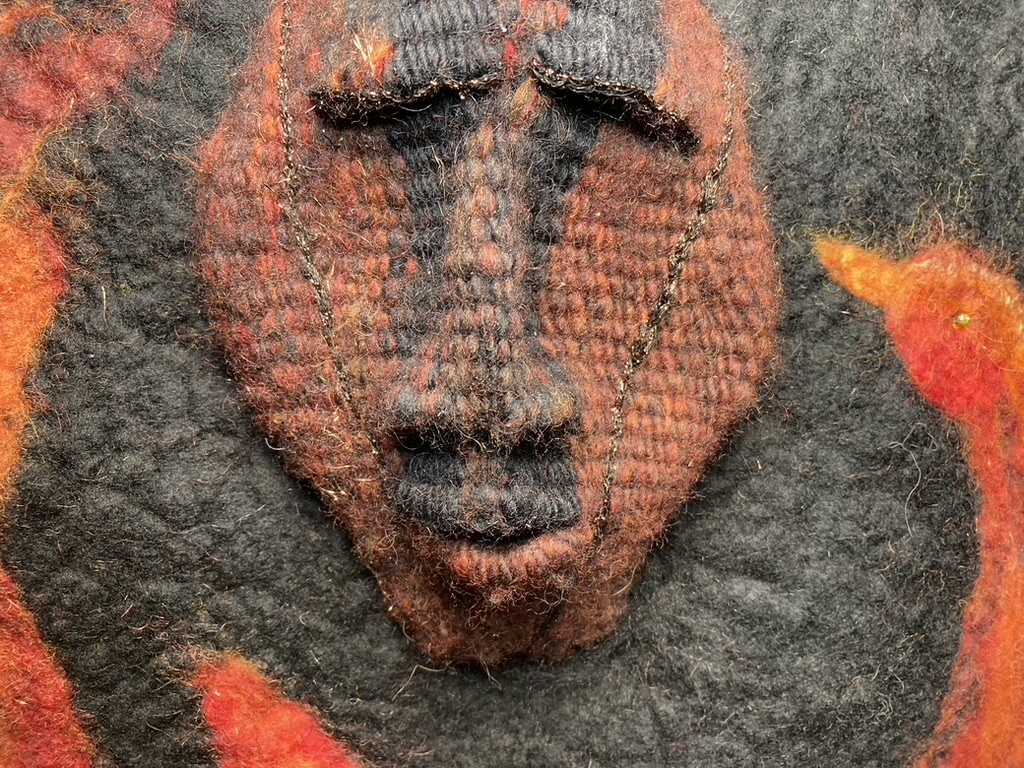
The mask whose I showed you last week is now off the loom — still in need of some final shaping and the sewing in of yarn ends, etc., but already very much itself.

When I first began putting that warp on the loom, I was obsessed with hair, about the way the warp should provide lovely flowing hair to integrate the completed mask/being into the environment. Well, as soon as I took this mask off the loom and placed it on the still-evolving background/context, I saw right away that he was a masculine spirit with no interest at all in long hair. Instead, what he requested — politely but firmly — was a consort.

She is beginning to emerge.

And who knows what will happen to the environment/context once the 2 spirit beings begin to settle in…?!

I wanted to include a photo, but everything is in flux — both in this making & in my life in general as we prepare to sell the house. [The first showings are May 11, next Wednesday. I hope Cris will get back from his week-long bicycle ride on Saturday to help with last minute stuff, but the weather where he is in Maryland isn’t looking good…. He’s riding the C&O Canal trail with a guy he met on his ride to the Midwest a couple years ago. They’re having great fun.]

And so this story goes on….. Always evolving — weaving & un-weaving & re-weaving — each thing changing in response to changes in its companions, as the fibers & I continue to dance together. I am curious about where our dance, our story, will lead us — both in this individual making and, even more, in the larger, troubling story that engulfs us all in its movements today.

I find hope in Pádraig Ó Tuama’s poem Narrative theology #1 which concludes:

"The answer is in a story
and the story isn't finished."

“What we are creating is creating us.”

(today’s title is a quote from Adah Parris)

In my 4/15 post, I lamented the “problems” I was having with my current project. Later, re-reading what I had written, I began to recognize that the situations I encountered & named “problems” weren’t problems with the fibers but problems with me! I had forgotten to maintain respect for all the partners in this co-evolution/co-creation — fibers, loom, and self. I had apparently forgotten that respect means respect not only for the gifts but also for the limits of each participant. In my mind, I can easily conjure up all sorts of exquisite possibilities — and I was spending too much time in my mind. Feeling some sort of need to hurry, I seem to have forgotten that only with relaxed awareness and respect can loom & fibers & self be woven together in the dialog through which the mask emerges. I’d forgotten the words of my teacher Luisa Teish: “Before you begin a new venture — especially before beginning a ritual — be sure to set a clear Intention. Every beginning is a crossroads where Trickster waits. If you have no clear Intention, Trickster will be happy to choose a path for you…. You may find you’re not happy with his choice.”

For me, work with fiber is a kind of ritual to bring blessings into the world. But, when I began this project, I had an idea rather than an Intention. And, sure enough, Trickster sent me down a path where I found myself seeking control, trying to force the fibers to comply with my grand idea. The further I went, the more muddled I became. Finally, I was completely immobilized by the knots into which I’d twisted both the fibers & myself. I was forced to pause and catch my breath — and as I began to breathe, I began to remember. I remembered and renewed my Intention of blessing through making. I remembered to respect all participants in the process & the process itself. I remembered to offer common courtesy both to the fibers & to myself. The tangles & snarls & knots fell away and a new path opened.

As I pondered this more deeply, I realized that I’d been unwittingly replicating some of the current cultural norms that I despise: I was effectively treating the fibers not as respected individuals but as “resources” that I could force to conform to the grandiose picture in my mind, to do what I wanted. Somehow feeling hurried & trying to push myself beyond my inherent limits, I was sliding into an arrogance akin to that of the culture that is currently engaged in the destruction of Earth community (including both human and more-than-human).

It is no coincidence that “Trickster” was the name used by more than one indigenous tribe to refer to the invading colonists, who — like the Tricksters of story & myth — ignored or willfully violated the limits/boundaries of the world as it existed (and who continue to do so today). I had refused to respect limits and had approached this particular act of making as Trickster might have done, so — just like Trickster — I got thoroughly entangled in the mess I’d made.

And yet, as Lewis Hyde says, “Trickster is the mythic embodiment of ambiguity and ambivalence, doubleness and duplicity, contradiction and paradox.” For all his trouble-making ways, “Trickster the culture hero is always present … to keep our world lively and to give it the flexibility to endure.” As the title of Hyde’s book says, “Trickster Makes This World.”

Having once more found a balanced relationship among materials, process, and self — having set out at last on my Intended path — I am now thoroughly enjoying the few hours I’ve found this week for making. It is once again not work but play. And the games the fibers & I are now playing with each other and the dances we’re inventing — while Trickster plays his flute! — are, for me, joyful times of growing, learning, and (dare I hope?) serving. Life just doesn’t get much better than that! And I can’t help but laugh with Trickster at the rough path he slyly pointed out as I began my current journey, because it — with all its aggravations — eventually lead me to deeper understandings & to possibilities I wouldn’t have imagined for myself. That old trickster!

In Beauty
the world is begun.

It is woven on the loom
of the Cosmos,
while Trickster
plays a song upon the warp,
tangles weft threads into
new configurations,
ties unexpected knots,
enlivens the simple surface 
with his rowdy dance.

In Beauty
it is begun.

In Beauty
it is woven.

In Beauty
it shall be finished.

“In and out, up and down, over and over, she wove her strands of life together, patching hole after hole. Eventually she saw it was much more than the threads that gave her strength; it was in the very act of weaving itself that she became strong.”

~ author unknown ~

Saunter & Gawk

Eighteen years ago I was fortunate to take a life-changing course entitled “The New Cosmology,” taught by Dr. Larry Edwards. It was a week-long intensive class with lots of reading & a paper before the gathering and more reading & a longer paper due a month afterwards. We looked briefly at the origin stories told not only by our Western cultures but also by other cultures around the wold, and considered how different origin stories were both creators of & products of the cultures in which they were found. We looked at the current scientific explanations/stories of cosmic evolution, Earth’s evolution, the evolution of Life, and finally — within the context of these larger patterns — human evolution. We considered the ways that the various species of plants and animals in an ecosystem help shape each other’s evolution, creating distinct traits and skills that interlock. And the human? What is our special trait? Perhaps, Dr. Edwards suggested, it is our ability to become fascinated by what we encounter, to wonder, to simply stop & gawk. One of my classmates added the word “saunter.” That’s it we decided: What makes us human is not simply our physiology or our technical achievements — it is our delight in sauntering & gawking — and then making up stories (whether scientific explanations or extended reflections) about what we’ve encountered.

“Saunter & Gawk!” That pretty much sums up my life this past week. Even in my fiber work, I’ve been doing a sort of saunter-and-gawk as I spend time in the company of some poorly-prepared llama and angora rabbit fibers — trying to understand the nature and “desires” of these tangled fibers. I’ve also been sauntering & gawking with delight in the natural world that surrounds me here and in the written world of ideas & discoveries & the records of unique personal experiences.

A brief question from my brother about a current forest fire here in North Carolina led to questions of geology, and I began saunter (and/or stumble) through information about the geology of this place in which I now find myself living. So much to learn! Much of what I encountered was beyond my comprehension, but I did stop to gawk at some wonderful surprises. I’d sort of assumed that the Piedmont where I live was mostly a result of the erosion of the Appalachian Mountains to the west. Who’d have guessed that this place was — before that — a chain of volcanic islands that were eventually squished between colliding tectonic plates?! Somehow seeing that deeper story of the land upon which I walk daily delights me and makes me feel more at home here.

Yesterday I came across an essay by David Abram which affirms our class’s “saunter-and-gawk” hypothesis. https://www.humansandnature.org/on-being-human-in-a-more-than-human-world In it, Abram begins by sharing the question that was inevitably asked every time he spoke about the human place in Earth ecology:

‘Alright, Dr. Abram, I understand when you say that we humans are completely embedded within a more-than-human world, and I understand your claim that many other animals, plants, and landforms are at least as necessary as humans are to the ongoing flourishing of the biosphere. But despite the attention and praise that you bestow upon other species, surely you must admit that humankind is something utterly unique in the earthly world?’

After musing about that question and his responses over the years, Abram goes on to say:

And after puzzling and pondering the matter, over and again, sussing out the signature traits of our species, I began to feel my way toward a fresh answer, one that rang true to me even as it seemed to satisfy my challengers—or at least to give them pause.

For if there’s something exceptional about us two-leggeds, it seems to reside in our ability to become interested in—even fascinated by—well, pretty much anything. Diverse other creatures, as I watch them go about their days, seem to stay fairly focused on a range of matters that concern their own well-being, indulging in other whims and curiosities now and then, but rarely ranging very far afield, with their sustained attention, from the sort of things that seem to grab others of their kind. But we humans have a peculiar proclivity to become fascinated and enthralled by the most incommensurable matters. Among even my close friends, there’s a person who closely studies the antler patterns of moose, another whose hobby involves documenting the life cycle of various lichens, and another whose expertise lies in throwing and baking the perfect Neapolitan pizza. That same baker is also a fine gardener who spends much of her week wooing various butterflies down from the skies to alight on the plants that she’s carefully cultivated for their delectation. There are people who steep themselves in the long-dead languages of lost cultures, and others who listen in on and try to decipher the long-distance utterances of humpback whales. Still others decline to consider those calls as linguistic, but concentrate their talents on playing music with whale songs….

So perhaps there is, indeed, something uniquely unique about our species. Yet we defy this uniqueness when we strive to assert what is most unique about humankind. Whenever we focus so exclusively upon ourselves, training our attention day after day upon the specialness of our species, then we are no longer enacting the very trait that most exemplifies our humanity. ”

Finally, Abrams — after contemplating the linguistic relationships among the words ‘human’ & ‘humus’ & ‘humility’ — counsels humans to remember their intrinsic interdependence with the larger community of other earth-beings and to act, therefore, with appropriate humility.

As I’ve been thinking about saunter-and-gawk, I’ve come round once again to Trickster, for that is what Trickster loves to do — to ramble along, to see something & to get curious about it. But then, thinking only of himself and his desires, Trickster stops looking and just jumps into the situation head first — only to find himself, time and again, in dreadful trouble. Humility is not to be found in Trickster’s vocabulary or in his actions!

Can there by any doubt about what message Trickster stories have for us these days?

*************

We are humans. Who are we?

We are listeners, listening to the song of the Land.
And we are one of the many voices to which the Land listens.
We are spinners, spinning wild fleece into Meaning.
And we are the fleece being spun into Meaning by others.
We are weavers, weaving radiant colors into Story.
And we are the colors, being woven into others’ Stories.
We are children standing in awe of Cosmic beauty.
And we are the Cosmos reflecting on Itself.
And when we sing praise songs, sing songs of gratitude,
Then we become a part of the Song.
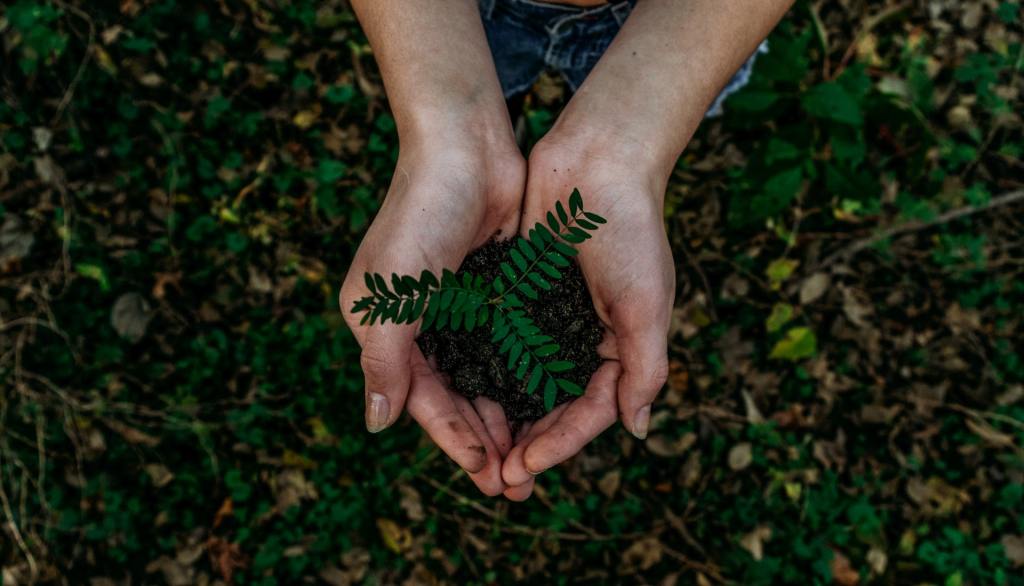
photo by Noah Buscher
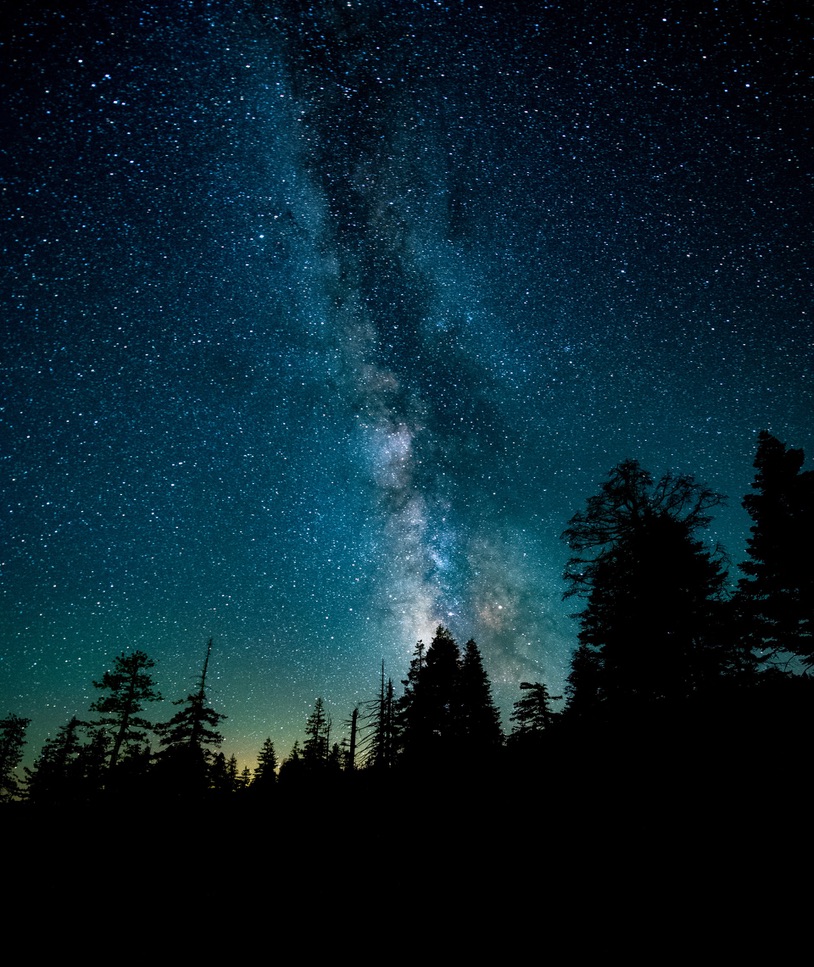
photo by Casey Horner

What is a Story?

Dear Ones, After a month or more of profound insomnia, my brain is on strike. I’m filled with questions, but as soon as I start to formulate one, a dozen new questions arise from it like a flock of crows and fly off in all directions, stealing all the meat from the few bony words I’d managed to arrange in my mind or on the page.

Today I have been pondering the definition, the concept, the limits of Story — but, like Trickster, Story’s meaning resists such cages, slips out between the bars or wastes away in captivity. Perhaps for me, “Story,” like “Trickster,” can only be approached as a koan.

We’ve all heard the Zen koan “What is the sound of one hand clapping?”

“…in the beginning a monk first thinks a kōan is an inert object upon which to focus attention; after a long period of consecutive repetition, one realizes that the kōan is also a dynamic activity, the very activity of seeking an answer to the kōan. The kōan is both the object being sought and the relentless seeking itself. In a kōan, the self sees the self not directly but under the guise of the kōan…When one realizes (“makes real”) this identity, then two hands have become one. The practitioner becomes the kōan that he or she is trying to understand. That is the sound of one hand.”

— G. Victor Sogen Hori, Translating the Zen Phrase Book

Linda Hogan, Chicksaw poet & writer, has simply said:

“To open our eyes, to see with our inner fire and light, is what saves us. Even if it makes us vulnerable. Opening the eyes is the job of storytellers, witnesses, and the keepers of accounts. The stories we know and tell are reservoirs of light and fire that brighten and illuminate the darkness of human night, the unseen.”

That which opens our eyes to “reservoirs of light and fire”….. There are many ways to open our eyes.

In a recent blog, Jude Hill https://clothwhispering.com/2021/06/18/it-comes-together-by-being/ describes her stitching of cloth as the telling of stories:

I do believe that artistic expression is rooted in witnessing the world around us and the need to understand and communicate, with ourselves and then with others. In order to do this, we choose a medium and I have chosen cloth. I like to use the word cloth because unlike textile or fabric, cloth most often refers to a finished piece of fabric that can be used for a purpose. And part of the purpose can be to communicate and that is where we find the story.

All my cloths are stories. They could be stories about the people I make them for, or stories about me. Or simply stories about life’s journey or nature or color or shape (this year it is the square). I consider stitching a cloth to be a sort of documentary, a time line of thought and process, no matter how long it takes. Telling a story is a way to share what you have learned through experience…and that is ultimately who you are. Story cloth may take many forms. It might be a story generated as the answer to a question, like “what is trees had feathers??? It could focus on a single word or thought like a magic feather which you might think about a lot until it becomes a personal symbol. Or, my favorite, a story cloth can be the story of the cloth making itself. Even a sampler is a story, a story of a little time spent on a specific technique, or a collection of wonderful memories stitched together into something useful. Even a beautiful piece of fabric has a story in it waiting to be told.”

  > Here I'd love to include examples of Jude's wonderful cloths but am defeated by technology 
-- hers or mine or some combination of the two.  
Please check out her work at 
https://www.instagram.com/spiritcloth/ 

How many ways can stories be told?

I tend to tell stories through written words, though I believe oral stories are far richer than printed ones. I guess I am also telling stories through my work with fiber (weaving, felting, etc.) but it really feels more like engaging in conversation. Indeed, if stories are being told, it is usually the fiber that is doing the telling! Sometimes in my work with both words & fiber I feel more like listener than teller. (Are the two separate?) In any case, in such engagements, my eyes are being opened to the reservoirs of fire and light Linda Hogan describes, and sometimes also to the ashes of fires past or to the shadows behind the flames — which are, in their own ways, sources of illumination as well.

How do you tell your stories?

As always, I’d love to hear your thoughts & your stories about Story.